
Reviewed · KIYOMIZU-DERA & HIGASHIYAMA TOURS
Kyoto: Kiyomizudera, Sanjusangendo, Kodaiji, and Gion.
Kyoto can feel overwhelming fast, but this route keeps it focused. I like how this tour strings together big-ticket classics like Sanjusangendo’s 1,001 Kannon statues and Kiyomizudera’s wooden terrace over the hillside in one smooth day. The main drawback is simple: there’s real walking on temple steps and old cobbled lanes, so comfortable shoes matter.
I also like the pacing: you get guided time at the major sites, then you’re given room to wander through Higashiyama and Gion on your own. With a small group of up to 10 and a live Spanish guide (often noted for clarity and good energy), it stays personal without feeling rushed.
In This Review
- Key moments that make this tour work
- A one-day loop through Kyoto’s classic sights
- Starting at Shichijō Station: how your day begins at 9:00
- Sanjusangendo’s 1,001 Kannon: a powerful, focused start
- The short on-foot stretch and moving toward Kiyomizudera
- Kiyomizudera’s hillside terrace: the view you came for
- Sannenzaka and Ninenzaka: old Kyoto streets in between temples
- Hōkan-ji (Yasaka Pagoda): the photo-stop with context
- Kōdaiji Temple and its bamboo forest: the quiet surprise
- Yasaka Shrine to Gion: learning geisha culture without turning it into a show
- Price and logistics: is $86 good value for 7 hours?
- Guide quality is part of the product
- Who should book this Kyoto day tour
- Should you book this Kyoto day tour?
- FAQ
- What is the duration of the tour?
- Where do I meet the guide?
- What language is the tour guide speaking?
- How large is the group?
- Which places are included?
- Is there walking during the tour?
- Do I need cash or a transport card for buses?
- Can I cancel and get a full refund?
Key moments that make this tour work
- A 120-meter hall devoted to mercy Kannon at Sanjusangendo
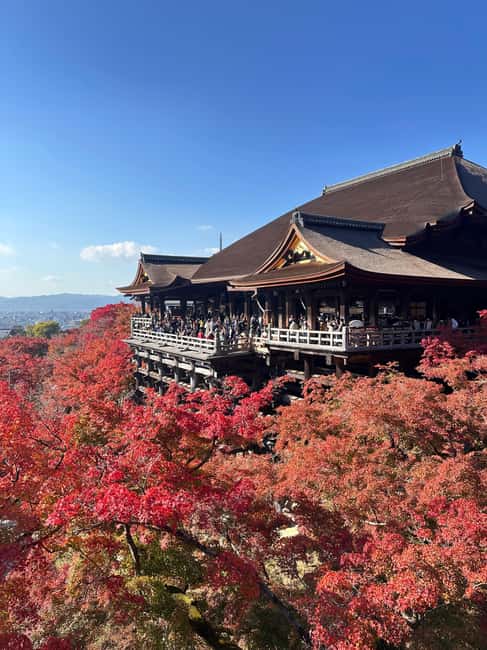
- Hillside views from Kiyomizudera’s wooden terrace
- Old Kyoto streets like Sannenzaka and Ninenzaka with craft-shop vibes
- Hōkan-ji (Yasaka Pagoda) as a picture-postcard stop
- Kōdaiji Temple’s bamboo forest inside the temple grounds
- Gion and Yasaka Shrine, plus context on geisha culture
A one-day loop through Kyoto’s classic sights
This is the kind of Kyoto day that makes sense if you want the highlights without spending your vacation glued to transit apps. You’re covering a classic sweep of central Kyoto: early on the temple-heavy side, then into Higashiyama, and finishing in Gion.
What makes it feel authentic is the mix. You’re not only doing big monuments. You’re also getting time in the older walking lanes—places where wooden houses and small shops make Kyoto look like it did before mass tourism.
More evenings along the lantern-lit lanes of Gion


Starting at Shichijō Station: how your day begins at 9:00
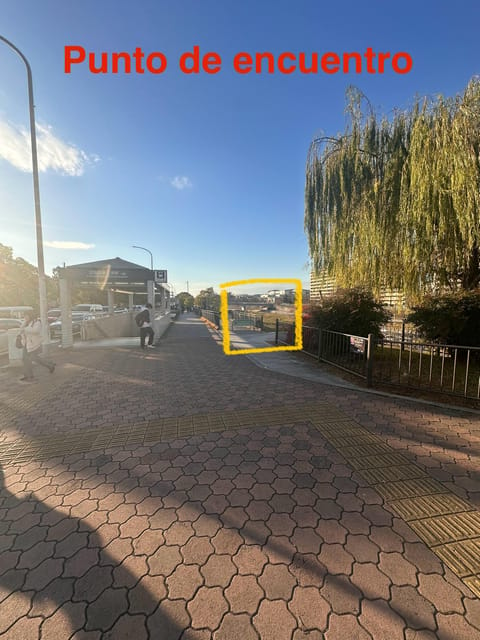
The tour meets at Shichijō Station, Exit 1, at 9:00 a.m., and it ends back in the Higashiyama area. That matters because you’re not starting in the middle of traffic-choked tourist streets. You start where you can connect easily, then head out into the quieter temple rhythm.
Buses are part of the day, and the practical note is to bring 230 yen in cash or use a transit card like ICOCA, SUICA, or PASMO. I treat that as a must-do. When you’re hopping between stops, it prevents small payment hassles from turning into time lost.
Sanjusangendo’s 1,001 Kannon: a powerful, focused start
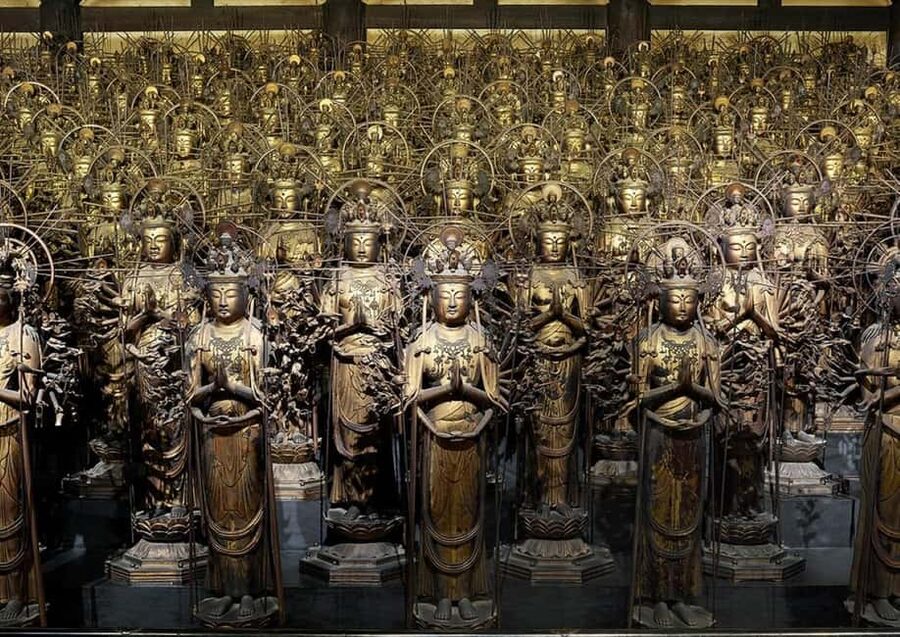
You kick off at Sanjusangendo Temple, and the wow-factor is instant. This is the famous long hall—120 meters—filled with 1,001 statues of Kannon, the goddess of mercy. The guide-led hour here is the right choice, because this kind of temple has details you can easily miss if you’re just rushing through.
After you absorb what you’re actually looking at, the scale starts to hit differently. You’re not looking at one statue, or even a few statues. You’re looking at an entire space designed for devotion—repetition with purpose. It’s one of those experiences where the building does half the explaining.
Practical tip: go in ready to slow down. Even with a guide, the main value comes from standing still long enough to let your eyes adjust to the hall.
The short on-foot stretch and moving toward Kiyomizudera
Between the first temple and the next big stop, you have a short walk. It’s not long, but it’s a good warm-up for what comes later: the day includes stairs, slopes, and uneven streets.
If you’re traveling with kids or anyone who tires quickly, this is where you should judge the pace. The rest of the route is manageable for most people with decent shoes, but Kyoto is not flat, and temple approach roads are part of the experience.
Kiyomizudera’s hillside terrace: the view you came for
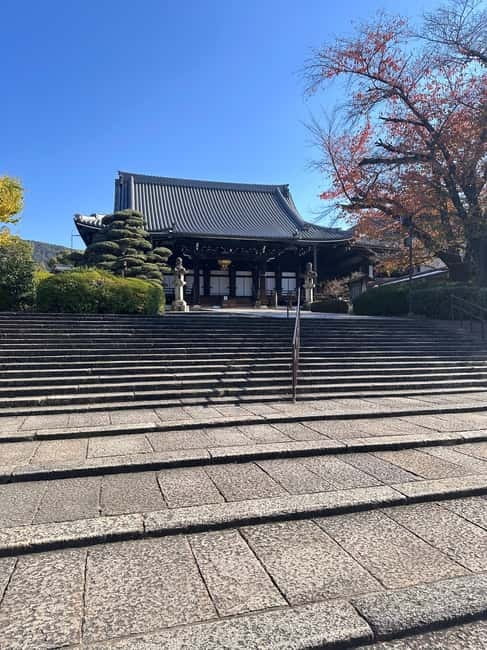
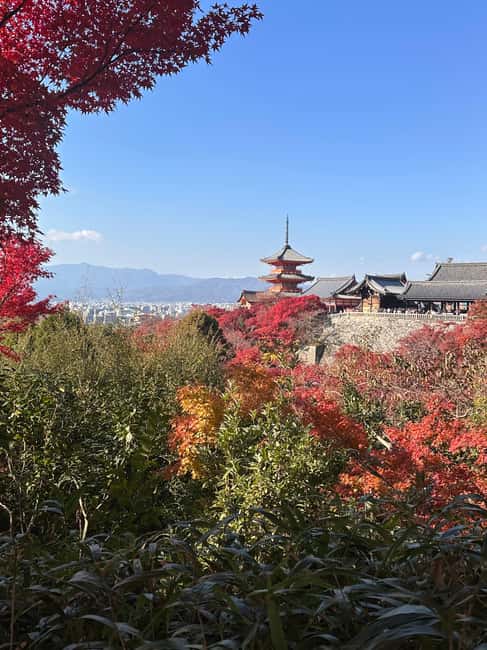
Kiyomizudera is the star for many people, and you’ll see why. The temple is known for its wooden terrace suspended on the hillside, a classic viewpoint over Kyoto. You spend about an hour here with a guided visit, which helps you understand what you’re seeing beyond the postcard angle.
I like this stop because it’s both dramatic and practical. Yes, you’re there for the famous terrace. But you also get the sense of how the temple sits in its environment—built to frame the valley and the city beyond.
This is also where Higashiyama starts to feel like a neighborhood rather than a checklist. Once you’re done inside and on the grounds, you head down through the old lanes that lead to the next chapter of the day.
Keep climbing the Higashiyama slopes toward Kiyomizu-dera

Sannenzaka and Ninenzaka: old Kyoto streets in between temples
On the way down, you stroll through two iconic cobbled streets: Sannenzaka and Ninenzaka. These lanes are known for wooden houses, craft shops, and the feeling that you’ve stepped into a quieter time loop.
This is the part of the tour where you should slow down on purpose. The best photos are often the ones that don’t involve rushing to the next landmark. Look for small storefront details and side streets, not just the main walkway.
Expect it to feel busy in peak times. If you want a calmer moment for pictures or just to breathe, pause where the lanes widen a bit, then move again when the crowd shifts.
Hōkan-ji (Yasaka Pagoda): the photo-stop with context
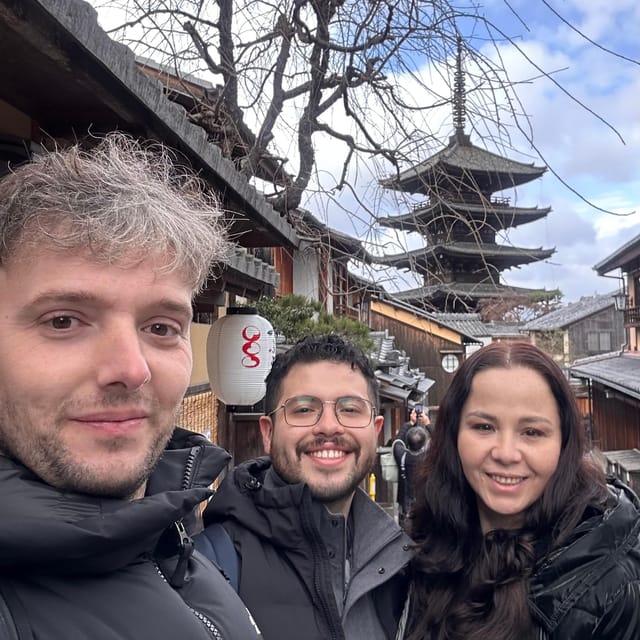
You’ll also stop at Hōkan-ji, better known for Yasaka Pagoda. It’s one of Kyoto’s most photographed icons, and this tour schedules a guided visit around it.
This short stop is valuable because the pagoda isn’t just a background object. With the guide’s explanation, you’re more likely to notice how it sits among traditional houses and street life. That’s what turns a single photo into a memory that actually means something.
I’d treat this moment as your break from long walking stretches. Even if you only spend about 30 minutes here with the guide, it’s a nice reset before the next temple zone.
Kōdaiji Temple and its bamboo forest: the quiet surprise
Kōdaiji Temple is dedicated to the Toyotomi family, one of the most important families in Japanese history. That historical link gives the visit extra weight, but the main reason people remember Kōdaiji is the bamboo forest inside the temple.
You’ll explore that bamboo forest during an hour-long guided visit. The route highlights it as a secret bamboo forest, and the effect is real: you go from street-level Kyoto noise into a more hushed, enclosed feel.
This is where the tour earns points for variety. After crowds and cobblestones, bamboo provides a different texture. Even if you’ve seen bamboo elsewhere, Kōdaiji’s setting inside the temple walls changes how it feels.
Practical tip: bamboo areas can be slightly cooler and quieter than the streets. If you plan to be out in summer heat, you’ll likely appreciate that break.
Yasaka Shrine to Gion: learning geisha culture without turning it into a show
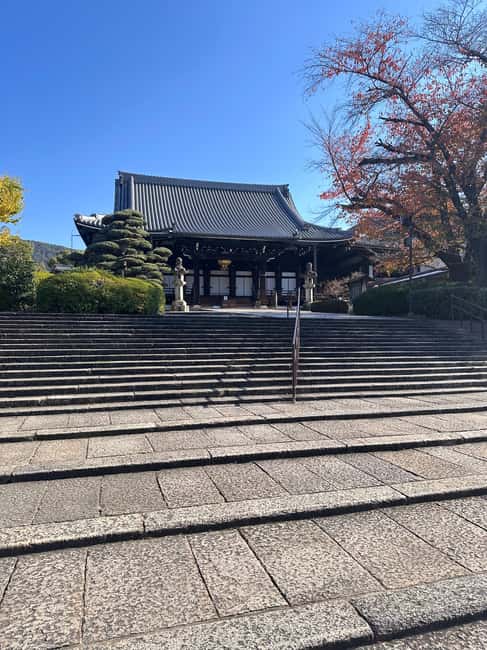
From Kōdaiji you head toward Yasaka Shrine, then into Gion. The tour includes a guided visit of Yasaka Shrine for about 30 minutes, followed by about an hour exploring Gion.
You’ll also learn about the culture of geisha and their history. What I like about this structure is that it ties the geography to meaning. You’re not only walking famous streets; you’re getting some context for why these places matter.
Then there’s Gion itself. This district is where Kyoto feels most like an old-world stage—yet it’s still a living neighborhood. I recommend moving slowly here, watching how people actually use the streets rather than hunting only for the most famous angles.
Etiquette tip: keep conversations low and avoid blocking sidewalks for photos. If you do want pictures, be polite and quick.
Price and logistics: is $86 good value for 7 hours?
At $86 per person for about 7 hours, this tour lands in the mid-range for Kyoto day experiences. You’re paying for more than just entry vibes. You’re paying for a guide who leads structured time at major sites, plus coordination so you’re not guessing routes between temple clusters.
Also, the group size cap at 10 is a big part of the value. A larger group can turn even great temples into a traffic line. Here, the day stays manageable.
The practical logistics are straightforward: the tour uses buses, includes on-foot segments, and gives you a clear start time at Shichijō Station. If you carry a transit card (or bring 230 yen), you’ll avoid little payment bumps.
One more value signal: recent feedback highlights personalization. In at least some cases, the group has effectively felt private or extra tailored, and that’s where a guide can be more responsive with explanations.
Guide quality is part of the product
A tour like this lives or dies on the guide. In the feedback you provided, the Spanish-speaking guide named Manuel gets consistently positive notes for being attentive and keeping the day fun. There’s also praise for clear explanations and for making the tour feel customized—sometimes even including help with a good lunch spot.
That combination matters. Kyoto temples can be visually stunning, but the context is what turns them into learning moments you’ll remember. If your guide explains what you’re seeing and keeps the pace comfortable, the day feels smoother and more enjoyable.
Who should book this Kyoto day tour
This tour fits well if you want a classic Kyoto highlight day that doesn’t require heavy planning. It’s especially good for:
- First-time visitors who want Sanjusangendo, Kiyomizudera, Kōdaiji, and Gion in one go
- People who like guided explanations but still want time to stroll
- Small-group travelers who prefer a less chaotic feel
It may not be ideal if you have very limited mobility, because the day includes walking, stairs, and slopes around temple areas. Baby carriages aren’t allowed, so plan around that if you’re traveling with very young kids.
Should you book this Kyoto day tour?
If your goal is to see Kyoto’s best-known temple sites plus the older streets and Gion atmosphere in one day, I think this is a smart booking. The route makes sense, the time allocation is practical, and the small group size keeps it from turning into a stampede.
Book it if you like structured guidance at the big temples and you want your Kyoto to feel like a connected neighborhood story, not separate photo stops. Skip it if you hate walking hills or you want a slower day with long breaks between sites.
If you do book, pack for the walking. Then let the guide do their job—so you can focus on looking, not navigating.
FAQ
What is the duration of the tour?
The tour lasts 7 hours.
Where do I meet the guide?
You meet at Shichijō Station, Exit 1, at 9:00 a.m.
What language is the tour guide speaking?
The live tour guide speaks Spanish.
How large is the group?
It’s a small group limited to 10 participants.
Which places are included?
The tour covers Sanjusangendo, Kiyomizudera, Kōdaiji, Yasaka Shrine, Gion, plus the Higashiyama area including Yasaka Pagoda (Hōkan-ji).
Is there walking during the tour?
Yes. The tour includes guided temple visits and walking time through the Higashiyama area.
Do I need cash or a transport card for buses?
Yes, it’s advisable to bring 230 yen in cash or use a transport card such as ICOCA, SUICA, or PASMO for bus travel.
Can I cancel and get a full refund?
Yes. Free cancellation is available up to 24 hours in advance for a full refund.
More Kyoto Temples and Shrines



More Along the Higashiyama Slopes
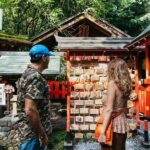
Still in Gion? Keep Going

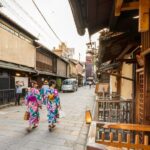

Just added: more Kyoto tours to browse








Kiyomizu-dera & Higashiyama Tours, compared.
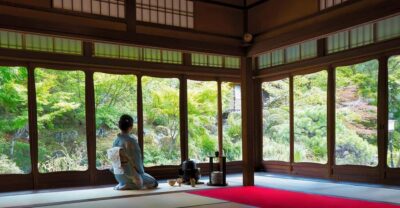 ★ 4.9Tea Ceremony in a Traditional Tea House in KiyomizuFrom $493,519 reviews
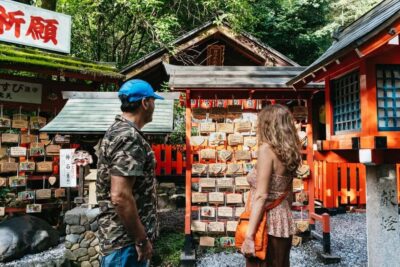 ★ 4.7Nijo Castle, Kiyomizu & Fushimi Inari Guided TourFrom $54700 reviews
 ★ 5.0Nijo, Kinkaku-ji, Arashiyama, Kiyomizu & Fushimi InariFrom $51699 reviews
 ★ 4.8Kyoto Ninenzaka: Tea Ceremony in Old Townhouse with ChairsFrom $21215 reviews
 ★ 5.0Private Rickshaw Tour of Gion and Higashiyama AreaFrom $51144 reviews
 ★ 5.0Kyoto Tea Ceremony & Kiyomizu-dera Temple Walking TourFrom $109115 reviews
 ★ 5.0Kyoto Kiyomizu Tea Ceremony with Scenic Garden ViewsFrom $50101 reviews
 ★ 4.7Kimono/Yukata Rental 5 Minute from Kiyomizu-deraFrom $1989 reviews
Browse the lists this tour appears in