
Reviewed · KYOTO SAMURAI & NINJA EXPERIENCES
Kyoto Samurai Discovery Samurai Sword Test Cutting Training
A real katana, not a prop. This Kyoto samurai sword test cutting experience happens inside Tozando Gion Yasaka and mixes hands-on practice with time to browse authentic swords and gear. Mobile ticket convenience and a small group make it feel personal, not like a factory class.
I love that you actually handle a real katana and do tameshigiri cutting, not just wave a sword around for photos. I also love the pacing: it’s short enough to fit temple plans nearby, and you still get coaching to calm nerves and build control. The one thing to think about is that this isn’t a long martial-arts training block—expect “learn the basics fast” rather than deep mastery.
In This Review
- Key Points You’ll Care About
- Where You Start: Tozando Gion-Yasaka in Kyoto’s Gion Area
- The Class Flow: How the Kyoto Katana Session Runs (Without Wasting Your Time)
- Your Tameshigiri Moment: Cutting Rolled Tatami Mats with Real Control
- The Katana, Costume, and Insurance: What’s Actually Included for $59
- After the Cut: Samurai Shop Browsing at Tozando Gion Yasaka
- Samurai Bar in the Basement: A Simple Way to End the Experience
- Group Size, Timing, and What to Do on the Rest of Your Day
- Who This Kyoto Samurai Discovery Class Is Best For
- Price and Logistics: Getting Value in Kyoto Without Stress
- Should You Book This Kyoto Samurai Sword Test Cutting Class?
- FAQ
- FAQ
- How long is the Kyoto samurai sword test cutting experience?
- Where do I meet for the experience?
- Do I need to bring a sword or costume?
- What will I be cutting?
- Is this a small group activity?
- Is transportation provided?
- Will I get any cultural explanation during the class?
- Is there a place to eat or drink afterward?
- How does ticketing work?
- Can I cancel for a full refund?
Key Points You’ll Care About
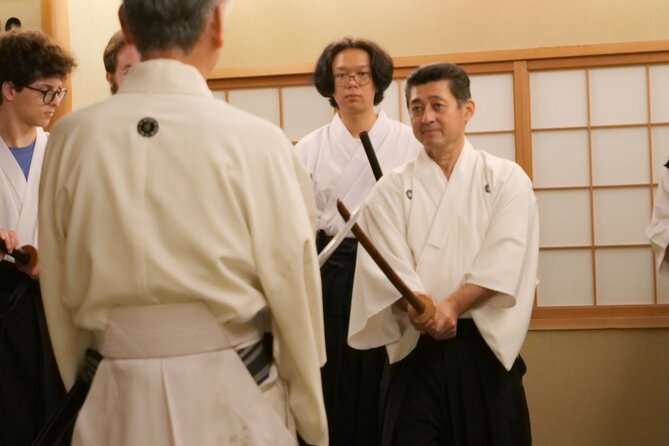
- Small group size (max 5) keeps the class calm and gives you enough attention to correct grip and posture.
- Real katana + costume + insurance are included, so you’re not juggling extra rentals or unclear coverage.
- Rolled tatami mat cutting lets you feel the difference between swings and clean, controlled cuts.
- About 15 minutes per person with a maximum of 30 minutes even as groups grow.
- Shop time after training means you can turn the experience into actual samurai shopping—swords and samurai gear.
- A basement Samurai Bar adds a fun, low-key end to the session.
Where You Start: Tozando Gion-Yasaka in Kyoto’s Gion Area
You meet inside Samurai Shop Tozando Gion Yasaka, at 542 Gionmachi Minamigawa, Higashiyama Ward. That matters because you’re not walking into a random dojo or a converted space. You’re stepping into a place that already feels like it lives for samurai culture: swords on display, gear around you, and staff used to helping visitors understand what they’re seeing.
This location is also handy for your day planning. You’re in Kyoto’s sightseeing zone, close to public transportation, and the timing is short enough that you can pair it with a nearby temple visit rather than sacrificing half your afternoon.
And yes, it’s a “theme” experience—but it’s also hands-on. You’re going to hold the real thing, under instruction, with the goal of cutting rolled tatami mats cleanly. That’s where the day becomes more than cosplay.
Pick up the blade again with these Kyoto sessions
The Class Flow: How the Kyoto Katana Session Runs (Without Wasting Your Time)
This is built as a quick, focused training block. Depending on the number of participants, you’re looking at roughly 15 minutes per person, with a maximum of 30 minutes total even if the group number increases. That short structure is part of the value—this isn’t a half-day commitment.
The flow typically looks like this:
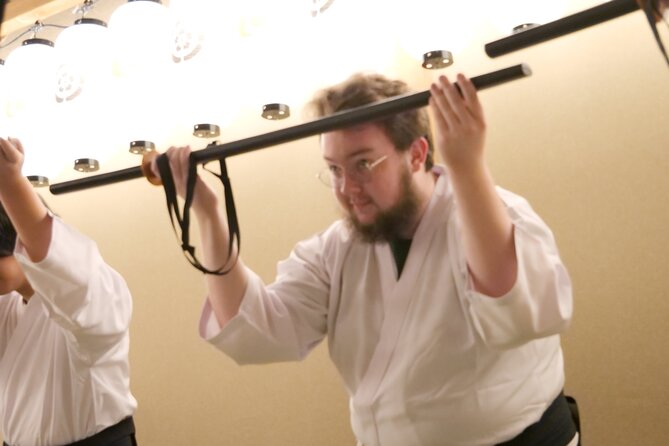
- Brief instruction on sword handling basics (how to hold and manage a katana safely and with control).
- Warm-up practice swings so your body learns the motion before you’re asked to cut.
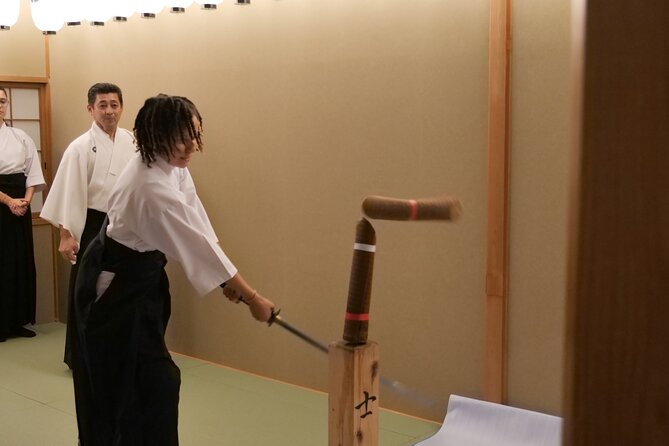
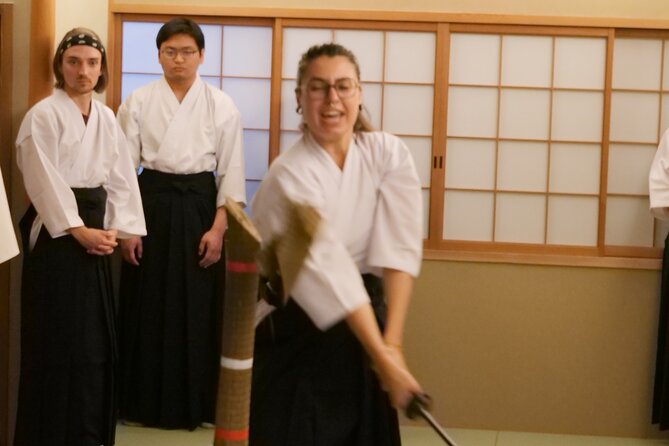
- Guided cutting practice using the tameshigiri setup with rolled tatami mats.
- Cultural takeaways that connect what you’re doing to Japanese swordsmanship mindset—precision, focus, and intent.
One review highlighted that the instructor was very reassuring because people often arrive nervous. That’s common. Even if you’re strong, a real sword can feel intimidating. The class is designed to get you moving in the right direction fast.
Also worth noting: one review said they record the session for you. Even if you’re not a “video person,” it’s nice to see your posture and swing choices afterward—because the cut is only half the story. Your stance and timing are the other half.
Your Tameshigiri Moment: Cutting Rolled Tatami Mats with Real Control
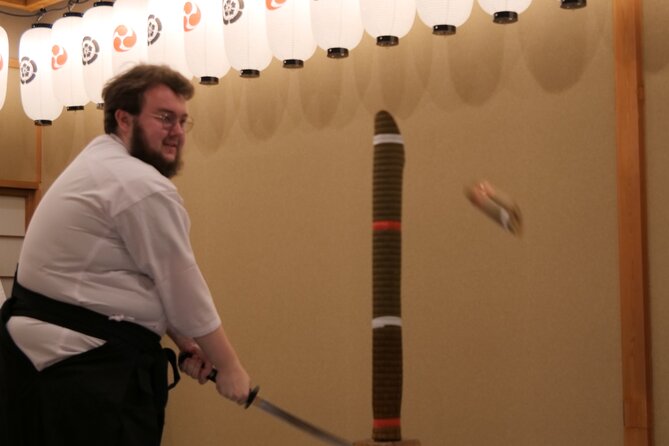
The main event is test cutting. You’ll cut rolled tatami mats during a tameshigiri session. Tatami is a practical choice for training: it’s consistent enough to practice, and it gives you a clear sense of whether your cut is clean and controlled.
What you should aim to feel during this part:
- Smooth handling: not just force, but control.
- Precision: lining up correctly matters more than swinging wildly.
- A shift from fear to focus: once your instructor has you set, it clicks.
In one review, participants said they learned to handle the katana and then cut tatami multiple times each. That’s a big deal. One attempt doesn’t teach you much. Multiple attempts help you adjust—stance, grip pressure, and where you place your focus.
Now, a realistic note: you won’t walk out a master. You’ll walk out with something better. You’ll walk out with a practiced sense of what a controlled cut feels like, plus a better understanding of why swordsmanship isn’t just about strength.
The Katana, Costume, and Insurance: What’s Actually Included for $59
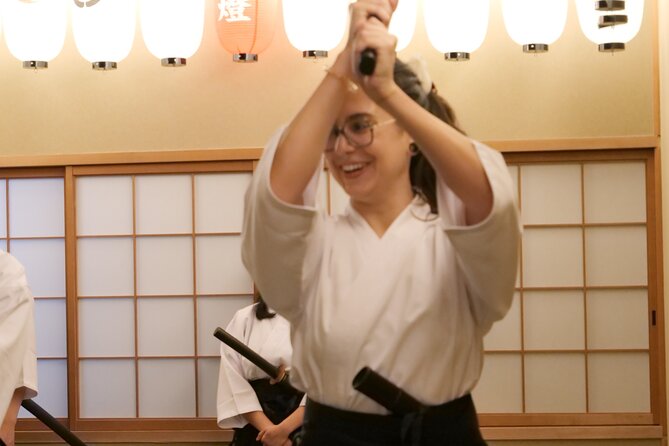
At $59, this is priced like a focused activity, not a full training course. The key is what you’re getting for that money. Your ticket includes:
- Katana
- Costume
- Insurance
- All fees and taxes
That’s the value equation. If you had to rent a sword, pay for insurance, or cover costume add-ons separately, the price would climb fast. Here, you’re paying for a complete “do it for real” experience.
The costume inclusion is also more than a gimmick. It helps set your body and mindset. The class is about posture and intention, and dressing the part can reduce the “I’m just playing around” feeling. It also makes photos and memories more fun—without you having to guess how to style anything.
Insurance is a quieter inclusion, but important. Test cutting with a real sword means there’s a real safety framework behind the scenes. The ticket being explicit about insurance is a comfort for first-timers.
If you’re traveling light, you’ll also appreciate what’s not on your checklist: this isn’t asking you to bring equipment. You show up, they provide the kit, and you follow instruction.
After the Cut: Samurai Shop Browsing at Tozando Gion Yasaka
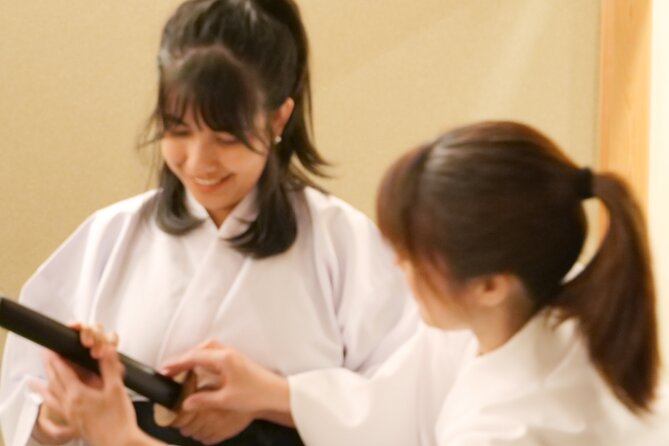
Once your training is done, you get to explore the shop. This is where the experience becomes more personal and less “one and done.”
Inside Tozando Gion Yasaka, you can browse:
- Authentic swords
- Samurai gear
- Items that connect directly to what you just practiced
This is useful even if you’re not buying. You’ll be able to look at sword types and gear with new context. The cutting lesson gives your eyes a reference point: you understand what you’re seeing, not just the romance of it.
Think of this as your chance to turn a short activity into a smarter souvenir hunt. Instead of buying the first thing that looks cool, you can compare, ask questions, and learn the differences you didn’t know existed before.






Samurai Bar in the Basement: A Simple Way to End the Experience
Down in the basement, there’s a Samurai Bar. It’s mentioned as a place to relax and soak in the atmosphere of legendary warriors—basically, your decompression zone.
This works well because after test cutting, you’re often mentally “on.” You’ve focused hard on technique and safety. A low-key bar stop helps you come down from that adrenaline and enjoy Kyoto without rushing to your next reservation.
It also makes the experience feel like a complete story:
learn → cut → reflect → relax.
Group Size, Timing, and What to Do on the Rest of Your Day
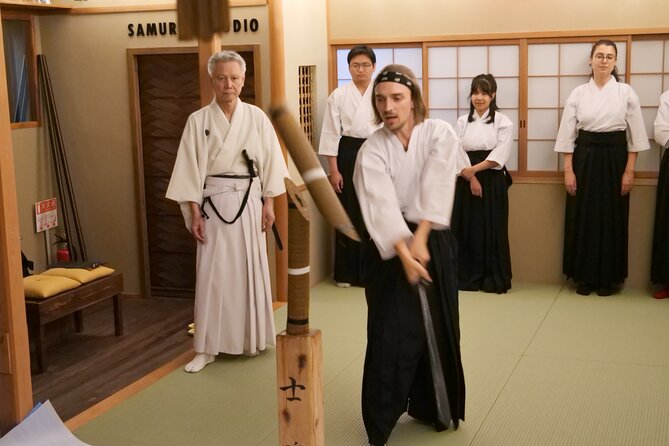
This class has a maximum of 5 travelers. In a hands-on activity, that small number is a gift. It usually means:
- more attention from the instructor,
- less waiting,
- and smoother transitions between instruction, warm-up, and cutting.
Timing is flexible based on group size. It’s roughly 30 minutes approx., but the real scheduling is better thought of as about 15 minutes per person. Even with more people, it shouldn’t run long—the stated cap is 30 minutes maximum.
So how should you plan your day?
- Pick a nearby start time so you’re not rushing in with temple tickets.
- Give yourself time to shop afterward.
- If you’re doing multiple activities, stack them so this one sits in the middle, not at the end when you’re tired.
If you’re the type who likes a tight itinerary, this fits well. If you’re the type who likes spontaneity, it still works because it’s short and easy to slot in.
Who This Kyoto Samurai Discovery Class Is Best For
This is a great fit if:
- you want a hands-on Kyoto experience beyond just walking and photographing,
- you’re a beginner who still wants a real katana and instruction,
- you’re a teen or adult looking for something memorable and active (one review specifically praised it as perfect for a teen and adults together),
- you like structured learning with clear outcomes.
It can be less ideal if:
- you’re expecting a long, advanced martial arts program,
- you want a “museum-style” experience only,
- you’re uncomfortable with handling a sharp tool (even with supervision and included insurance).
The good news: the class is built around “most travelers can participate,” and instructors are there to guide you through the basics and keep you comfortable.
Price and Logistics: Getting Value in Kyoto Without Stress
Let’s talk value directly. $59 for real katana handling, costume, insurance, and tatami cutting is strong—especially in a city where “experience” prices can spike fast. The big reason it feels like good value is that it includes what most other sword activities leave out or make you pay for separately.
Logistics are simple:
- You’ll meet at Tozando Gion Yasaka.
- The experience ends back at the meeting point.
- You’ll use a mobile ticket.
- It’s near public transportation.
One practical tip: arrive a few minutes early, even if you think you’ll be on time. Kyoto streets can be smooth or confusing depending on how your GPS behaves, and this is a short experience. You want to start relaxed, not scanning the storefront with your heart racing.
Should You Book This Kyoto Samurai Sword Test Cutting Class?
If you want one Kyoto activity that’s physical, memorable, and culturally tied to real technique, I’d book it. The combination is the selling point: real katana, guided fundamentals, tameshigiri cutting, then shop time at Tozando Gion Yasaka, plus a basement Samurai Bar.
Book it if:
- you’re curious about samurai sword culture and want more than stories,
- you like short, well-paced activities that fit a day of temples,
- you want a high-reward experience for a mid-range price.
Skip it if:
- you’re looking for a deep multi-hour training immersion,
- you prefer purely passive sightseeing,
- you’re sensitive to the idea of using a real sword, even with instruction.
FAQ
FAQ
How long is the Kyoto samurai sword test cutting experience?
It’s approximately 30 minutes. The time can change depending on group size, with about 15 minutes per person and a maximum of 30 minutes even with more participants.
Where do I meet for the experience?
You meet at Samurai Shop Tozando Gion Yasaka, 542 Gionmachi Minamigawa, Higashiyama Ward, Kyoto, 605-0074, Japan.
Do I need to bring a sword or costume?
No. The katana, costume, and insurance are included.
What will I be cutting?
You’ll cut rolled tatami mats during the tameshigiri test cutting session.
Is this a small group activity?
Yes. The tour/activity has a maximum of 5 travelers.
Is transportation provided?
No. Private transportation is not included.
Will I get any cultural explanation during the class?
Yes. You’ll receive cultural insights into samurai swordsmanship as part of the guided training.
Is there a place to eat or drink afterward?
There is a Samurai Bar in the basement where you can relax after the training.
How does ticketing work?
You’ll have a mobile ticket.
Can I cancel for a full refund?
Yes, you can cancel for a full refund up to 24 hours in advance. If you cancel less than 24 hours before the start time, the amount paid is not refunded.
If you tell me what else you’re doing in Kyoto that day (temples, walking tour, food stops), I can suggest a simple schedule so this fits smoothly without rushing.
More Tour Reviews in Kyoto
More Samurai and Ninja Sessions

Just added: more Kyoto tours to browse








Kyoto Samurai & Ninja Experiences, compared.
 ★ 5.0Kyoto Samurai ExperienceFrom $1191,294 reviews
 ★ 4.9Kendo and Samurai Experience with Uniform and GearFrom $103815 reviews
 ★ 4.9Samurai Sword Class by Experts in Traditional ArtsFrom $64657 reviews
 ★ 4.5Skip the lines Basic Ticket at SAMURAI NINJA MUSEUM KYOTOFrom $28632 reviews
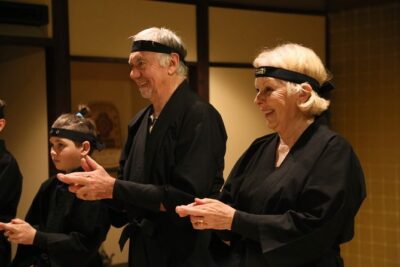 ★ 5.0Ninja 1-hour Hands-on Lesson by Japanese master in Kyoto -EntryFrom $80489 reviews
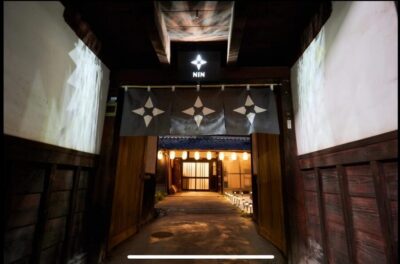 ★ 4.8Ninja Weapon Forging ExperienceFrom $148478 reviews
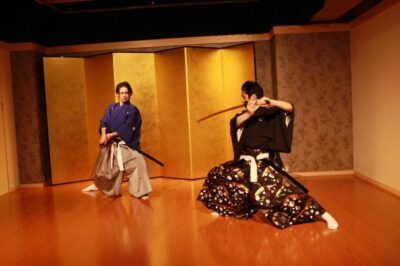 ★ 4.5Samurai Kenbu Traditional Sword Dancing ShowFrom $32426 reviews
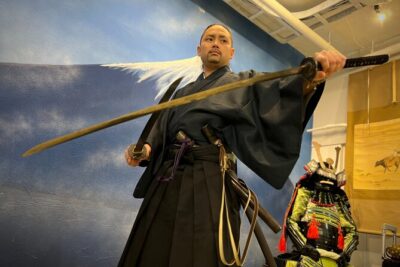 ★ 5.0Samurai Training with Modern day Musashi in KyotoFrom $132256 reviews
Browse the lists this tour appears in