
Reviewed · GION & GEISHA DISTRICT TOURS
Kyoto: Meet the Geisha Maiko with Gion Walking Tour
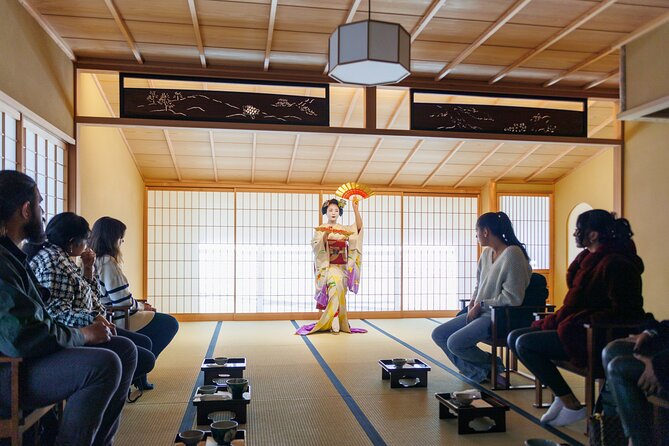
Geisha culture isn’t something you see from behind rope. It’s something you’re invited to understand. This 3-hour Gion walking tour ends with a rare visit to a private ochaya, where you meet a maiko and a retired geiko and watch a live performance.
I especially like that the tour is built around real context, not just pretty streets. You’ll learn what geisha and maiko do, how their arts are tied to Kyoto’s social world, and you get a chance to ask questions—often with translation support—so it makes sense while you’re there.
One possible drawback: the experience depends on how well the guide’s voice carries and how efficiently the walking portion is paced. If you’re expecting nonstop sightseeing highlights for the entire 3 hours, you might feel the time more than you hoped.
In This Review
- Key things I’d watch for before you go
- Why this Gion tour feels different from street-watching
- Gion Shirakawa: where the lifestyle stories start
- Tatsumi Daimyojin Shrine and the shortcut-feeling of Gion
- Hanamikoji Street and the art-forward stops
- The performance at Miyagawasuji: socks, stairs, and real conversation
- Price and value: what $109.43 is really paying for
- Who this tour is for (and who should skip it)
- Practical tips to get the most from your ochaya night
- Should you book Kyoto: Meet the Geisha Maiko with Gion Walking Tour?
- FAQ
- How long is the Kyoto geisha maiko and Gion walking tour?
- Where does the tour start and end?
- Is the tour a walking tour?
- What’s the main event at the end of the tour?
- Do I need to bring socks?
- Are photos and video allowed?
- Is there a dress or weather requirement besides socks?
- How big is the group?
- Is this tour suitable for children?
- What’s included in the price?
Key things I’d watch for before you go
- Private ochaya access in Gion, typically closed to first-time visitors
- Meeting both a maiko and a retired geiko, not just watching from a distance
- A guided Q&A with translation support, which is where the experience often becomes unforgettable
- Max group size of 30, helping the interaction feel more intimate than the usual crowd
- Socks-only etiquette at the performance venue, plus extra care on rainy days
- Stairs to a 2nd-floor performance, so plan for comfortable movement and shoes
Why this Gion tour feels different from street-watching
In Kyoto, it’s easy to fall into the tourist habit: you scan alleys, hoping to spot a geiko or maiko on a lucky stroll. This tour flips that approach. Instead of chasing people, you get a guided path through the district’s geography and customs—then you’re taken inside a private setting where the performance and conversation happen.
That matters because geisha culture isn’t just costumes and dance. It’s training, etiquette, and a careful relationship to place. When you understand why Gion looks the way it does—wooden machiya houses, tea house doors, shrine corners you’d normally rush past—you notice details you’d otherwise miss.
You also get the kind of interaction most visitors never manage. A maiko performs, a retired geiko is present, and you’re positioned to ask questions. If you love cultural experiences that go beyond photos, this is the main reason people rate it so highly.
More evenings along the lantern-lit lanes of Gion


Gion Shirakawa: where the lifestyle stories start
The tour begins in Gion Shirakawa, a section of Gion known for its classic streetscape feel. Your guide’s focus here is practical: who geisha are in Kyoto, how the lifestyle works, and what the arts are tied to in daily routines.
This first stop is short, but it sets the tone. You’ll walk away with a framework for interpreting what you’ll see later. For example, you’ll be less likely to treat every dark doorway and narrow lane as a mystery and more likely to understand them as parts of a long-standing social world.
Tip: this is where you want to settle in and pay attention. If you get restless before the main event, you’ll miss the clues that make the rest of the walk click.
Tatsumi Daimyojin Shrine and the shortcut-feeling of Gion
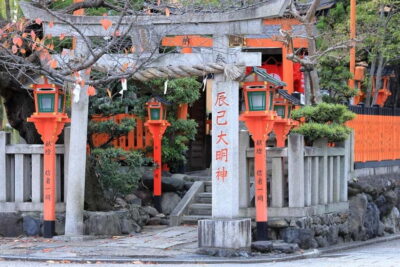
Next comes Tatsumi Daimyojin Shrine, a Shinto shrine tied to protection, good fortune, and safety for travelers and even warriors. It’s said to have been founded during the Heian period (794–1185), and the stop is brief.
After that, you’ll pass Tatsumi Bridge, a small traditional bridge in a corner of Gion. The area around it feels like a set: wooden machiya houses close in, and the street texture changes from “attraction” to “local detail.”
These parts are quick, but they help you see how Gion mixes layers. You’re not only looking at tea house fronts and entertainment lanes. You’re also moving through the kinds of sacred and everyday landmarks that have always shaped neighborhood life.
Hanamikoji Street and the art-forward stops
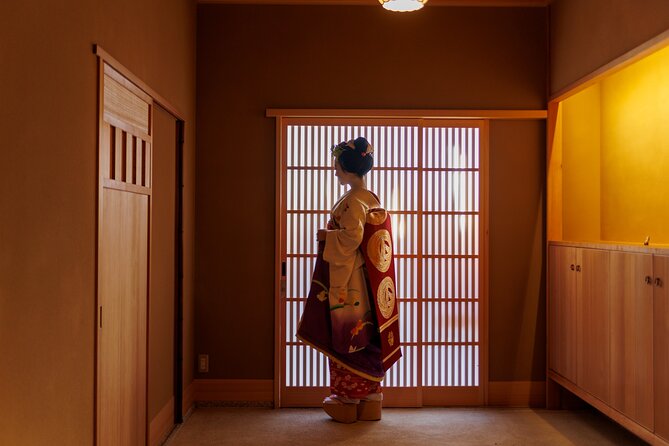
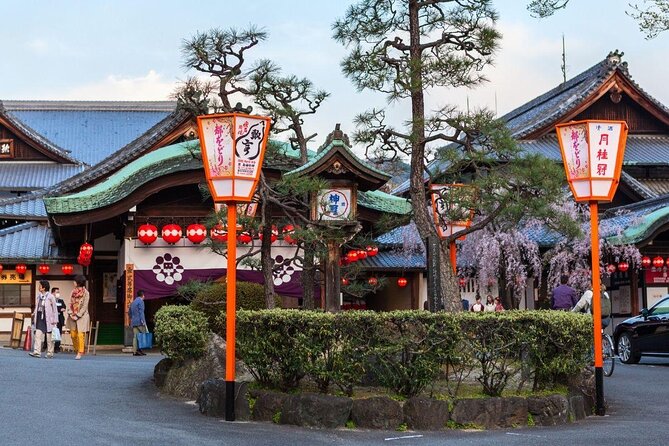
When you hit Hanamikoji Street, you’re back on the main thread of Gion. This is where the traditional machiya houses, tea houses, and shops line up along a street that feels old-world elegant. It’s a great moment to slow your pace, because the guide is usually tying visual details to stories.
From there, the tour includes cultural stops that steer you toward understanding the arts side of Kyoto’s tradition. One is Gion Corner, described as a venue that showcases traditional art performances highlighting Kyoto’s cultural heritage. Another is a Zen Buddhist temple precinct nearby the geisha district. You won’t go into the temple buildings, but you’ll walk through the grounds like locals.
Even if you don’t plan to spend much time in temples on this day, these stops help you connect the performance you’ll see later to the larger world of Japanese arts and etiquette. It’s the difference between watching something beautiful and understanding what it belongs to.
The performance at Miyagawasuji: socks, stairs, and real conversation
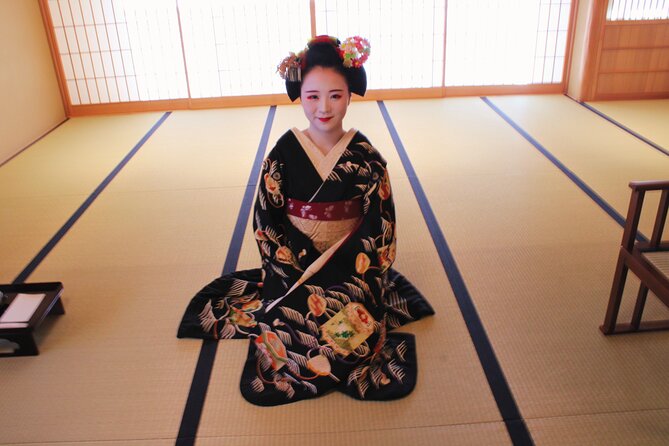
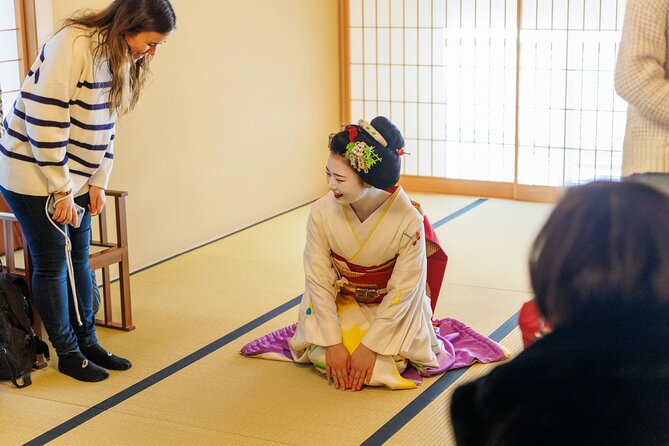
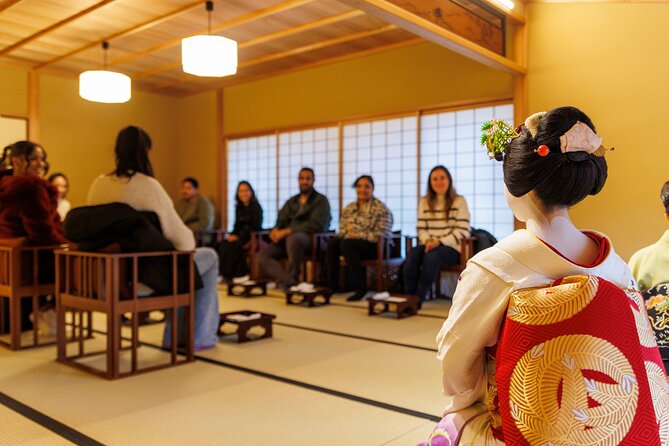
The heart of the experience happens at Miyagawasuji, where you enjoy a professional performance at a traditional tea house setting. The guide translates so you can understand the culture and history in the room, and you’ll have a chance to talk with the maiko.
Here’s what you should treat as non-negotiable details:
- You must wear socks at the venue of the performance.
- The performance is held on the 2nd floor of an exclusive private house, and stairs are required.
- The tour runs rain or shine. On rainy days, the rules also call out that no wet cloth and socks are allowed at the venue, so you’ll want an umbrella and dry socks.
In plain terms: arrive prepared so you can focus on the experience, not on logistics.
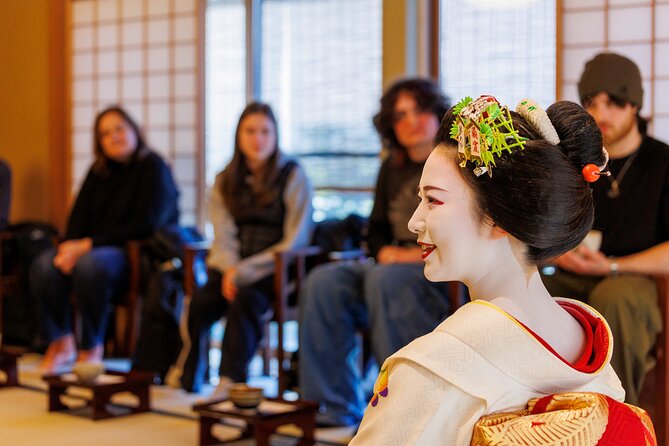
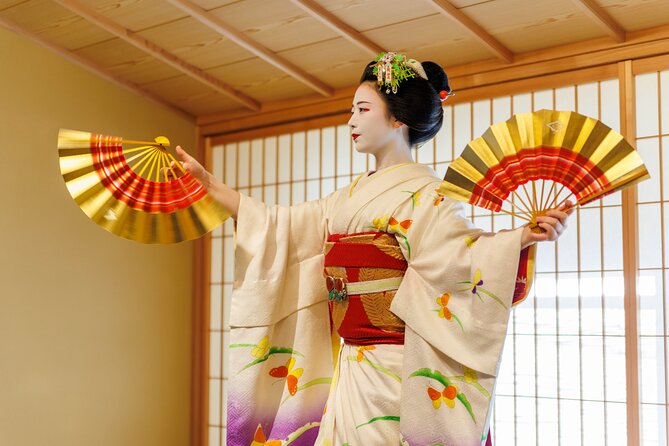
What makes this part special is that it isn’t just a staged show with a quick smile-and-leave. You meet a maiko and a retired geiko, watch a performance, and then you’re placed for questions and conversation. The maiko is an apprentice geisha, and the story-sharing is described as personal—more “how this life works” than “facts on a slide.”
Photography and phone behavior matter here too. You can take photos and video only during the performance and the photo session. If you want to upload to social media, you need direct permission from the maiko beforehand. That’s part of why this visit feels controlled and respectful rather than chaotic.
Other Kyoto tours and experiences to compare




Price and value: what $109.43 is really paying for
$109.43 sounds like a lot until you look at what you’re buying. A basic Gion walk with a guide can be cheaper. This tour charges for three costly things that most visitors can’t access:
- Entry to a private ochaya setting (described as ultra-rare and typically off-limits)
- Time with a maiko plus a retired geiko, including conversation
- A live performance in a controlled, etiquette-heavy environment
There’s also a hidden value: you’re not spending your time guessing. The guide handles context, and translation is part of the plan for you to understand what’s happening inside.
That said, price sensitivity is a real consideration. If you mainly want wandering around Gion with lots of landmarks and you’re not especially interested in the geisha arts side, you may feel that the walking portion could be more exciting. If you’re here specifically for the ochaya meeting and performance, the pricing makes more sense.
Who this tour is for (and who should skip it)
This is a strong fit if you:
- want an inside look at geisha culture through conversation and performance
- like a guide-led walk where you learn what you’re seeing
- can follow etiquette rules like socks and photography permissions
- are comfortable with a walking tour that’s rain or shine and includes stairs
I’d think twice if you:
- want a broad sightseeing day with lots of stops and long time at each place
- are sensitive to translation getting lost in softer-spoken moments
- hate the idea that some of the walk may feel like repositioning inside Gion’s streets rather than “tour bus view hopping”
Practical tips to get the most from your ochaya night
- Bring dry socks if the weather might turn. The venue rules are strict.
- Wear comfortable walking shoes. This is a walking tour, and the end includes stairs.
- Listen early. The first part gives you the vocabulary for what you’ll see later.
- Ask questions at the right time. When you’re offered Q&A, that’s where the tour becomes more than a show.
- Be careful with phone habits. Photography is limited by the performance schedule, and social posting needs permission.
Should you book Kyoto: Meet the Geisha Maiko with Gion Walking Tour?
I’d book it if your ideal Kyoto day includes a guided walk through Gion’s meaning, followed by a rare private ochaya visit with a maiko, a retired geiko, and an actual live performance plus Q&A. This is the kind of experience that feels hard to recreate on your own.
I’d skip it if you’re mainly after general neighborhood sightseeing, temple hopping, and lots of independent time. The event you’re paying for is specific, and the walking portion is there to set up that moment—not to replace a full day of classic Kyoto touring.
If you fit the first group, this is one of the best ways to trade street-chasing for a respectful, structured look at a living Kyoto tradition.
FAQ
How long is the Kyoto geisha maiko and Gion walking tour?
The tour is about 3 hours.
Where does the tour start and end?
It starts and ends at Miyagawasuji, Higashiyama Ward, Kyoto, 605-0801, Japan.
Is the tour a walking tour?
Yes. It includes walking through the Gion area and is described as rain or shine.
What’s the main event at the end of the tour?
You’ll watch a live performance at a traditional tea house setting and meet a maiko and a retired geiko, with translation support from the guide.
Do I need to bring socks?
Yes. You must wear socks at the venue of the performance.
Are photos and video allowed?
Photography and video recording are allowed only during the performance and the photo session. For uploading photos to social media, you need direct permission from the maiko beforehand.
Is there a dress or weather requirement besides socks?
On rainy days, the venue does not allow wet cloth and socks. The tour recommends using an umbrella during the walk.
How big is the group?
The tour has a maximum of 30 travelers.
Is this tour suitable for children?
No children under 10 years old are allowed.
What’s included in the price?
The tour includes the guided experience and the performance/meeting described in the tour features. Extra food and drink are not included.
More Tours in Kyoto

More Tour Reviews in Kyoto


Still in Gion? Keep Going

Just added: more Kyoto tours to browse








Gion & Geisha District Tours, compared.
 ★ 4.7Kyoto Geisha Walking Tour: Gion District & Hidden GemsFrom $253,273 reviews
 ★ 4.9Gion Magical Night Walking Tour with Geisha TriviaFrom $242,393 reviews
 ★ 4.7Gion Geisha District Walking Tour – Stories of GeishaFrom $202,187 reviews
 ★ 4.9Best of Kyoto: Gion, Geisha, Pagodas & CobblestonesFrom $242,058 reviews
 ★ 4.5Night Walk in Gion: Kyoto’s Geisha DistrictFrom $212,003 reviews
 ★ 5.0Kyoto Night Foodie Tour in Gion (9+ dishes + 6 Sake tastings)From $1631,762 reviews
 ★ 5.0Kyoto Gion Geisha District Walking Tour – The Stories of GeishaFrom $251,441 reviews
 ★ 5.0Kyoto Gion: 2-Hour Geisha Culture & History Walking TourFrom $231,186 reviews
Browse the lists this tour appears in