
Reviewed · WORKSHOPS
Pure Silver Spoon Making Workshop in Kyoto
Make one real spoon of silver in Kyoto. This pure silver spoon workshop is about an 8-minute walk from Shugakuin Imperial Villa, and you’ll go home with a spoon you helped shape. Since ancient Japan, silver was seen as a talisman against misfortune, and there’s even a tradition of gifting a silver spoon to a baby for happiness.
What I like most is how hands-on the whole process is, from adding your own pattern to forming the bowl of the spoon. I also love the human touch: the host team welcomes you with tea and snacks, and the language barrier is handled with English instructions prepared in advance and patient guidance.
One consideration: this is focused craft time, not a sightseeing tour. You’re making a spoon sized for daily use like a teaspoon, so if you want big temple views and lots of walking around Kyoto, plan that separately.
In This Review
- Key highlights you’ll care about
- A Pure Silver Spoon Workshop Just Steps from Shugakuin
- Meeting Point Flow: Easy to Find, Easy to Return
- The 2.5-Hour Workshop: What You’ll Actually Do
- Step 1: Your spoon starts with pattern time
- Step 2: Hammering turns metal into the spoon shape
- Step 3: Filing and burnishing refine the sides
- Step 4: Machine polishing first, then your finishing polish
- Step 5: Packaging in a paulownia box
- The Size and Use: What Kind of Spoon This Really Is
- Why This Experience Feels Authentic (Not Just Hands-On)
- Price and Value: How $141.22 Adds Up
- Getting the Most Out of Your 2.5 Hours
- Who Should Book This Workshop, and Who Might Skip It
- Booking Timing: Plan Ahead, Even for a Small Day
- Should You Book Pure Silver Spoon Making in Kyoto?
- FAQ
- How long is the Pure Silver Spoon Making Workshop?
- Where does the workshop meet in Kyoto?
- Is transportation included?
- Is this a private experience?
- What’s included in the price?
- What should I expect to make?
- How big is the finished spoon?
- Do I need to print anything?
- Is free cancellation available?
Key highlights you’ll care about
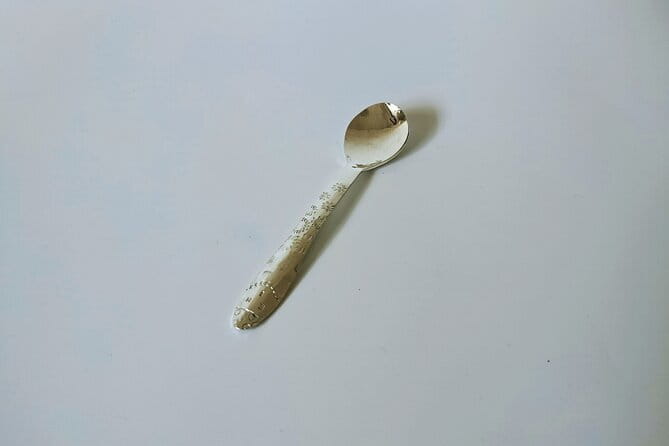
- Pure silver spoon, not a souvenir trinket: you form and finish a real spoon from silver material.
- Your design choices: add a favorite pattern using the chisel or stamp provided.
- Step-by-step tool work: chisel/stamp, hammer shaping, then filing and burnishing for the sides.
- Safety-minded polishing: polishing is done on a machine first, then you polish by hand at the end.
- Gift-ready packaging: your spoon goes into a paulownia box, ready to give or keep.
A Pure Silver Spoon Workshop Just Steps from Shugakuin
Kyoto has craft studios all over the city, but this one is special because the craft is practical. You’re not making a decorative item you’ll forget in a drawer. You’re making cutlery-sized silver—the kind of object you’ll actually want to hold and maybe use.
The location helps too. The meeting point is at 1-15 Shūgakuin Yamanohanachō, Sakyo Ward, and it’s described as an 8-minute walk from Shugakuin Imperial Villa. Even if you’re not planning to visit the villa itself, that area keeps the workshop away from the densest tourist routes.
And the theme of silver adds extra meaning while you work. Silver has long been treated as a protective talisman in Japan, and there’s a baby-gift tradition tied to happiness. It’s a nice reminder that your spoon isn’t just a cool craft project—it’s part of a cultural story.
Other Kyoto tours and experiences to compare


Meeting Point Flow: Easy to Find, Easy to Return
This experience starts and ends back at the meeting point, so you’re not dealing with complicated drop-offs. That matters in Kyoto, where you can easily lose an hour to trains, transfers, or just walking the wrong way.
The workshop is near public transportation, and it’s a short walk from the Shugakuin Imperial Villa area. You’ll get a mobile ticket, so you can keep things simple on arrival—no printed paperwork hunting.
One more practical note: it’s a private tour/activity, meaning only your group participates. So you’re not sharing attention with strangers when you’re chiseling, hammering, and polishing. That private pace is a big part of why the experience feels calm instead of rushed.
The 2.5-Hour Workshop: What You’ll Actually Do
The session runs about 2 hours 30 minutes, and the structure is clear: design, shape, refine, polish, finish. If you like step-by-step instructions and getting your hands dirty, you’ll probably feel right at home.
Here’s how the work typically unfolds, in the order you’ll follow.
Step 1: Your spoon starts with pattern time
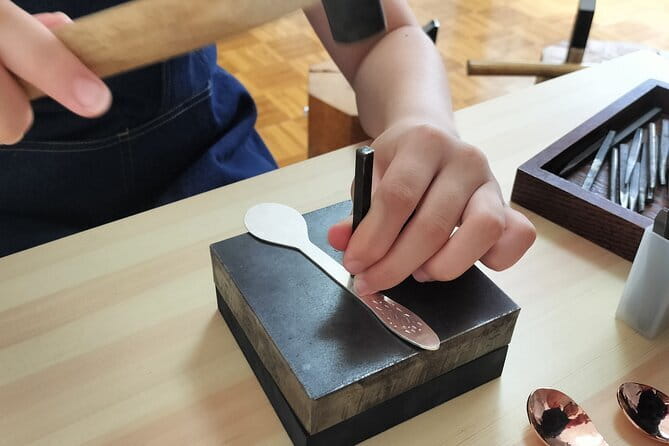
You begin by choosing a pattern for the spoon fabric prepared for you. Using a chisel or stamp of your choice, you’ll carve or impress your design. This is the moment that turns a piece of metal into something personal.
Don’t worry if your pattern skills are basic. The whole setup is built for making a spoon, not testing your artistic talent. The key is to follow the craftsman’s guidance on how hard to press and where to place your marks.
Step 2: Hammering turns metal into the spoon shape
Next comes the satisfying transformation: you hit it with a hammer to form it into a spoon. It’s not just decorative. You’re physically shaping the bowl and the overall silhouette so it can function like a teaspoon.
This part feels different from typical crafts because the metal fights back a bit. That’s also the fun: you can see the shape change in real time.





Step 3: Filing and burnishing refine the sides
Once the general shape is there, you smooth the sides using a file and burnisher. Think of this as the quality-control phase. The edges need to be comfortable, and the surface needs to be even.
This is where you’ll notice how much effort craftspeople put into making objects pleasant to use. A spoon isn’t a sculpture you can leave rough. It should feel right in the hand.
Step 4: Machine polishing first, then your finishing polish
Then the process gets two-stage. A craftsman polishes it using a machine for safety and consistent results. After that, you polish it yourself with an abrasive.
That split is a smart design choice for visitors. You get the confidence and control of hands-on finishing, without skipping the professional polish stage. It’s also a great way to learn what final texture actually takes—one more reason the result looks sharp, not just “worked on.”
Step 5: Packaging in a paulownia box
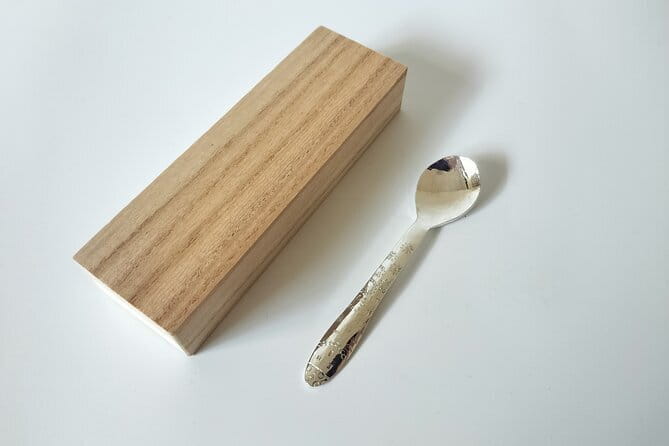
When you’re done, your finished spoon is placed in a paulownia box. This isn’t just storage. In Japan, paulownia boxes are often used for items you want to keep long-term or gift with care.
If you’re buying a souvenir for someone, this packaging makes it instantly gift-ready. If it’s for you, it also protects the spoon so it stays in good condition.
The Size and Use: What Kind of Spoon This Really Is
The approximate finished size is 12cm long and 2.7cm wide. That size points to the spoon being best for teaspoons and similar uses, not large serving spoons.
This matters for expectations. If you picture a full-size table spoon, you might feel surprised. But if you want a compact, everyday spoon you can use for tea, small tastes, or dessert portions, this size is exactly right.
Also, since you’re recommended for teaspoon use, plan to treat it like a personal item. It’s small enough to be meaningful, and the silver makes it a little special every time it touches the table.
Why This Experience Feels Authentic (Not Just Hands-On)
I like craft workshops that balance freedom with structure. This one gives you choices—your pattern—while still guiding you through the steps with professional care.
A standout from the experience vibe is the hosting. You’ll be welcomed with tea and snacks, and the language barrier is handled with English instructions. That’s not a small thing. In workshops, clarity is everything. If you’re guessing at the tool or the technique, your hands start working harder than your brain.
The reviews also point to the hosts being patient, and that patience shows up in the way the workshop likely runs: careful instruction, time to catch up, and supportive correction. That’s what keeps a visitor from feeling clumsy or rushed.
And don’t ignore the location’s role. Being near Shugakuin Imperial Villa means your afternoon isn’t trapped in the busiest tourist grid. It feels more like Kyoto’s quieter side—villages, gardens, and craftsmanship—rather than a race to the next photo spot.
Price and Value: How $141.22 Adds Up
At $141.22 per person, you’re paying for more than a class. You’re paying for materials and skilled labor—especially the silver itself. Silver isn’t cheap, and it’s also the part that makes the finished object genuinely valuable and usable.
The cost includes:
- Material
- Rental of tools
- A paulownia box
- A metal polishing cloth
That package changes the math. Many workshops include instruction but make you buy your own supplies. Here, you’re handed tools and materials needed to make a finished spoon.
Duration also plays a role. 2 hours 30 minutes is long enough to do real work from start to finish, not just watch and leave. And since it’s private for your group, you’re not splitting the craftsman’s time with multiple parties.
One more note: the workshop doesn’t include private transportation. That’s normal for Kyoto day activities. Just budget for the ride/walk to the meeting point.
Getting the Most Out of Your 2.5 Hours
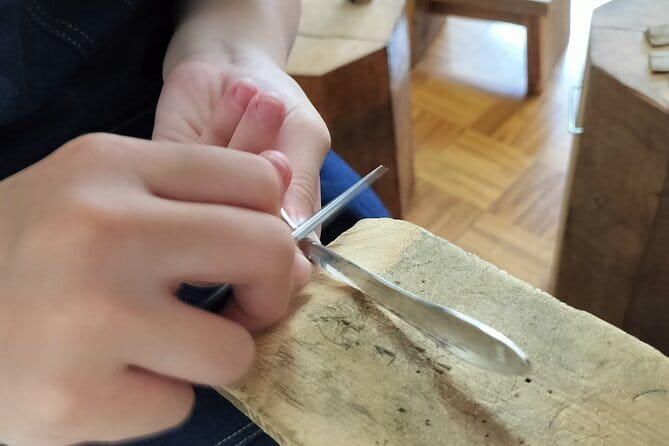
Here’s how to set yourself up for success once you arrive.
First, show up ready to concentrate. You’ll use tools—chisel/stamp, hammer work, and polishing—so it helps to be mentally in the task rather than scanning your phone every five minutes.
Second, embrace slow learning. The best part of the day isn’t finishing fast. It’s getting the spoon shape right and getting comfortable with the finishing steps. The machine polishing helps with safety, but your hand polishing is where you can really see the surface change.
Third, plan your day around the workshop, not after it. You’ll be working for 2.5 hours and likely feel a bit hands-on tired afterward. It’s a great activity to anchor your afternoon.
Finally, think about how you’ll use it afterward. A teaspoon-sized silver spoon makes sense for tea and small bites. If you’re gifting it, the paulownia box makes presentation easy.
Who Should Book This Workshop, and Who Might Skip It
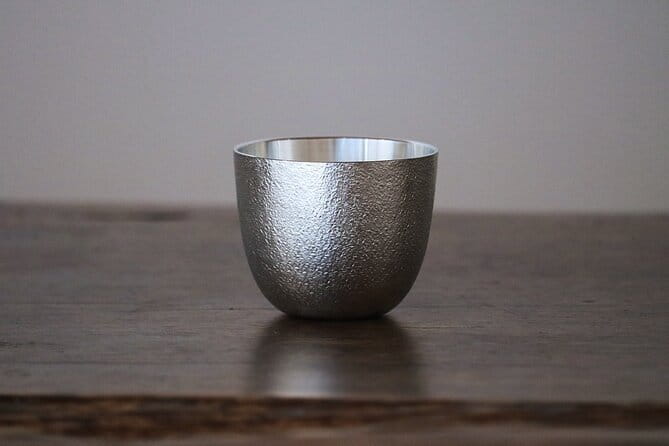
This is a strong fit for you if:
- You like making something with your hands, step-by-step
- You want a souvenir that’s functional, not just decorative
- You enjoy traditional crafts and want a culturally rooted story (silver as talisman, baby-gift tradition)
- You prefer a calmer part of Kyoto away from the busiest streets
It may be less ideal if:
- You want a classic temple-and-shrine sightseeing morning/afternoon combo
- You’re not interested in tool work or careful finishing
- You expect a full-size spoon or a large serving piece
For families, couples, and solo travelers, the private format is a nice bonus. It also says most travelers can participate, and service animals are allowed.
Booking Timing: Plan Ahead, Even for a Small Day
This workshop is typically booked about 30 days in advance on average. That’s a useful signal. Craft slots can fill up, especially in quieter neighborhood areas that attract visitors seeking a slower Kyoto day.
If your dates are fixed, don’t wait for the last minute. You’ll have a better chance if you secure your spot early and then plan the rest of your day around it.
Should You Book Pure Silver Spoon Making in Kyoto?
Yes, I’d book it if you want one memorable Kyoto souvenir with real weight, real craftsmanship, and real everyday use. The mix of pattern choice, shaping with hammer work, and the two-stage polishing makes the experience feel complete in about 2.5 hours.
You should also book it if you appreciate thoughtful hosting. A workshop that welcomes you with tea and snacks—and handles English instructions clearly—turns a potentially intimidating metal project into a friendly learning experience.
Skip it only if your top goal is sightseeing first. This is a workshop day. The reward is the spoon, the process, and the quiet Kyoto atmosphere—not a checklist of landmarks.
FAQ
How long is the Pure Silver Spoon Making Workshop?
The workshop lasts about 2 hours 30 minutes.
Where does the workshop meet in Kyoto?
The meeting point is at 1-15 Shūgakuin Yamanohanachō, Sakyo Ward, Kyoto 606-8025, Japan. It’s described as an 8-minute walk from Shugakuin Imperial Villa.
Is transportation included?
No. Private transportation is not included.
Is this a private experience?
Yes. It’s a private tour/activity, so only your group participates.
What’s included in the price?
Included are the material, rental of tools, a paulownia box, and a metal polishing cloth.
What should I expect to make?
You’ll make a spoon from pure silver and add a pattern using a chisel or stamp, then shape it with a hammer, refine it with filing and burnishing, and polish it (machine polishing first, then your own polishing).
How big is the finished spoon?
The approximate finished size is 12cm long and 2.7cm wide, recommended for use as teaspoons.
Do I need to print anything?
No. You’ll have a mobile ticket.
Is free cancellation available?
Yes. You can cancel for a full refund up to 24 hours in advance of the experience’s start time (local time).
More Workshops in Kyoto


More Tour Reviews in Kyoto
Just added: more Kyoto tours to browse








Workshops, compared.
 ★ 4.345-Minute Tea Ceremony Lesson ExperienceFrom $222,378 reviews
 ★ 5.0Ramen Cooking Class at Ramen Factory in KyotoFrom $1311,937 reviews
 ★ 5.0Chopsticks Making Workshop in Gion with Engraving OptionFrom $15958 reviews
 ★ 4.9Samurai Sword Class by Experts in Traditional ArtsFrom $64657 reviews
 ★ 4.9Ramen Cooking Class at a Ramen Factory with SouvenirFrom $127532 reviews
 ★ 5.0Ninja 1-hour Hands-on Lesson by Japanese master in Kyoto -EntryFrom $80489 reviews
 ★ 5.0Ramen, Gyoza, and Onigiri Cooking ClassFrom $90445 reviews
 ★ 5.0The Original Small-Group Sushi Making Class in KyotoFrom $69436 reviews
Browse the lists this tour appears in