
Reviewed · FUSHIMI INARI SHRINE TOURS
Kyoto Early Bird English Tour: Fushimi Inari & Gion(Private opt)
Start early. Your schedule still feels light. This Kyoto tour strings together the big icons—Fushimi Inari and Gion—plus Kiyomizu-dera and classic old-street strolls, all with an English-speaking local guide who helps you understand what you’re seeing (and takes photos along the way). It’s a smart way to cover a lot without feeling like you’re sprinting through maps all morning.
I especially love the practical focus: early in the day, then walking stop-by-stop with photo time and context at each place. I also like the extra care from the guide, including professional photo-taking and lots of room to ask questions, with standout guide names like Ikki (and occasionally Jay helping out).
One thing to consider: the tour duration is listed as 4 to 5 hours, but at least one guest found it closer to about 2.5 hours depending on pace and time at each site. Also, Kiyomizu-dera has an admission fee not included, so budget that extra cost.
In This Review
- Key highlights to know before you go
- Getting from Kyoto Station to Yasaka Shrine without fuss
- Stop 1: Fushimi Inari-taisha and the torii path before it gets loud
- Stop 2: Kiyomizu-dera viewpoints and the one fee to plan for
- Stop 3: Sannenzaka and Ninenzaka’s old-street stroll
- Stop 4: Yasaka Pagoda (Hokanji) and its nail-free legend
- Stop 5: Yasaka Koshin-Do and its colorful contrast
- Stop 6: Gion’s traditional streets and geisha district atmosphere
- Stop 7: Yasaka Shrine, the bigger network behind one main shrine
- Why the guides make (or break) the experience
- Price and logistics: what you really pay for
- Timing reality: 4 to 5 hours, but plan like it might be shorter
- Who this Kyoto early-bird tour fits best
- Should you book this Kyoto Early Bird English Tour?
- FAQ
- How long is the Kyoto Early Bird English Tour?
- What is included in the tour price?
- What extra costs should I expect?
- Where does the tour start and end?
- Is the tour a walking tour?
- What’s the cancellation policy?
Key highlights to know before you go
- Fushimi Inari first thing: see the torii gate path before the worst crowd pressure.
- Photo support built in: your guide takes professional photos during the tour.
- Real explanation at temple and shrine stops: you’re not just walking past signs.
- Short old-town detour: Sannenzaka and Ninenzaka add that classic Kyoto street feeling.
- End in the Gion area: finish at Yasaka Shrine, then keep sightseeing on your own.
- English tour with local context: guides like Ikki are repeatedly praised for clear communication.
Getting from Kyoto Station to Yasaka Shrine without fuss

The tour starts at Kyoto Station (Higashishiokoji Kamadonocho, Shimogyo Ward). That’s a good choice if you’re staying in central Kyoto, because you can usually reach the meeting area with simple transit. The operator also lists the meet point as near public transportation, so you’re not hunting down a remote corner of the city.
You’ll use public transportation and plenty of walking. The tour is designed as a walking experience, and it’s a private setup for your group only, so you won’t feel rushed around a big crowd. A moderate fitness level is recommended, which basically means: wear comfortable shoes and don’t treat this like a couch tour.
The finish is at Yasaka Shrine (625 Gionmachi Kitagawa, Higashiyama Ward). That ending matters. When you wrap up near Gion, you’re already in the area where you can keep wandering, grab a snack, or take the next bus or route to your hotel. The guide will help you plan your best route after the tour.
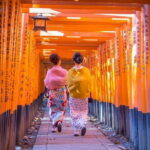
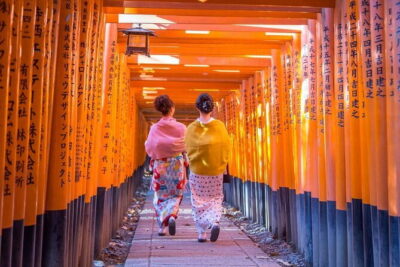
More walks up through the vermilion torii of Fushimi Inari

Stop 1: Fushimi Inari-taisha and the torii path before it gets loud
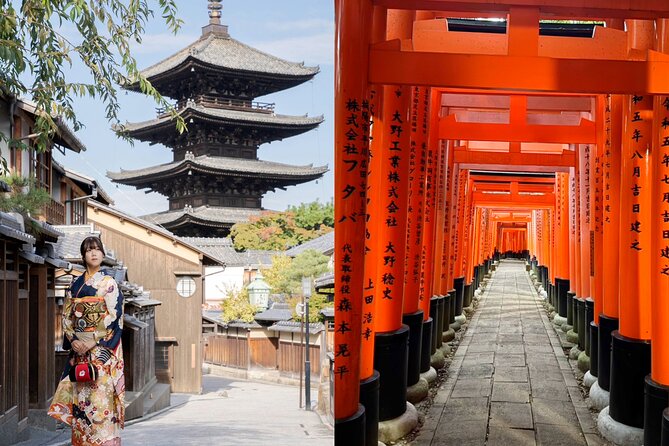
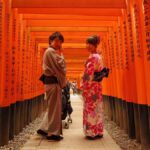
Fushimi Inari-taisha is one of Kyoto’s most recognizable shrines, famous for thousands of red torii gates that create a long walking path up the slopes of Mount Inari. This tour hits it as the first stop, which is the whole early-bird point: you get a calmer start and more breathing room for photos.
Expect about 1 hour here. Admission is free, so you’re not paying to enter the shrine grounds. Your guide can help you make sense of what you’re seeing as you move through the torii tunnel effect—what the shrine is dedicated to, and why the gates and pathways matter.
Practical tip: this is where good photo pacing helps. If you want images that look like you’re not standing in a human traffic jam, the early start is doing real work for you. The guide taking photos during the tour is also a plus, because you don’t have to keep handing your phone back and forth to strangers.
Stop 2: Kiyomizu-dera viewpoints and the one fee to plan for
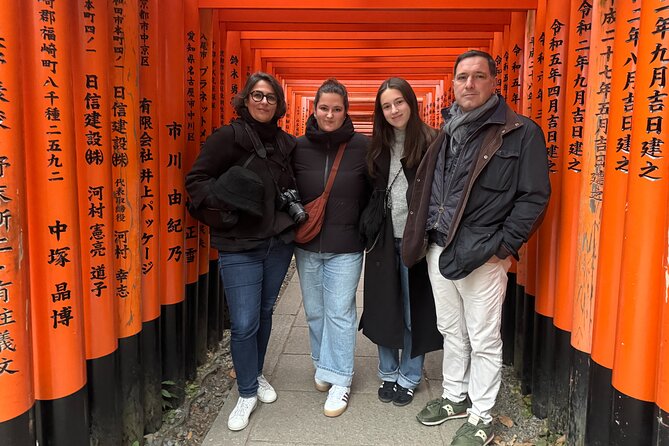
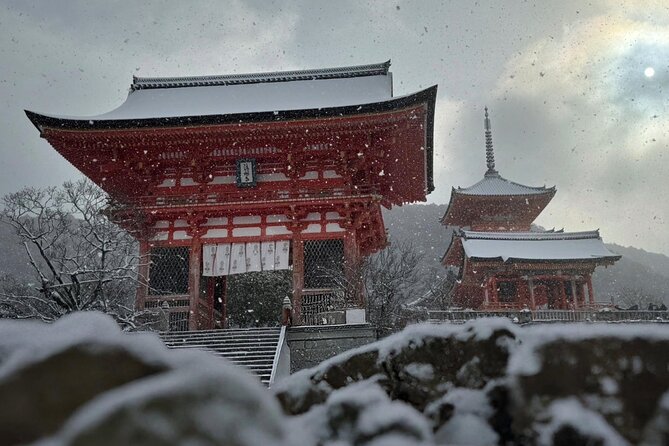
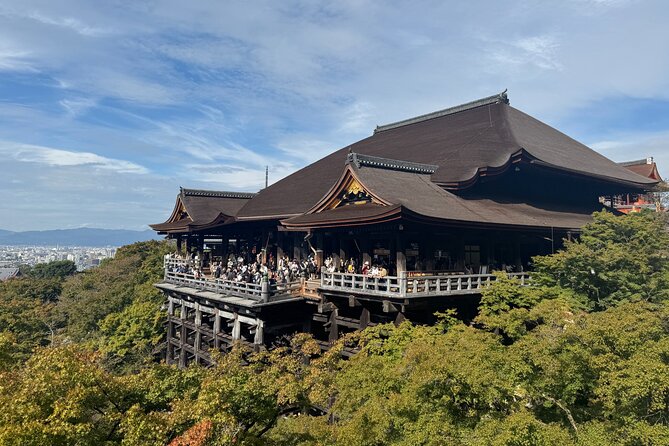
After Fushimi Inari, the tour moves to Kiyomizu-dera for another 1 hour. This is Kyoto’s “wow from the hill” stop, with panoramic city views from the temple area—exactly the kind of place where knowing what you’re looking at makes a difference.
Here’s the budget detail: Kiyomizu-dera admission is ¥500 per person, and it’s not included in the tour price. Public transport fare is also listed separately (¥390 per person). So even though the headline tour price looks straightforward, you should be ready for a couple add-ons once you’re in the thick of it.
Why this stop works in the tour flow: you get the contrast. Inari is gates and forest-like walking. Kiyomizu is stone, structures, and wide views. If you try to do both on your own, it’s easy to waste time figuring out the best route and entry timing. With a guide, you spend more energy actually seeing.
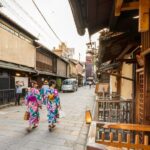
Stop 3: Sannenzaka and Ninenzaka’s old-street stroll
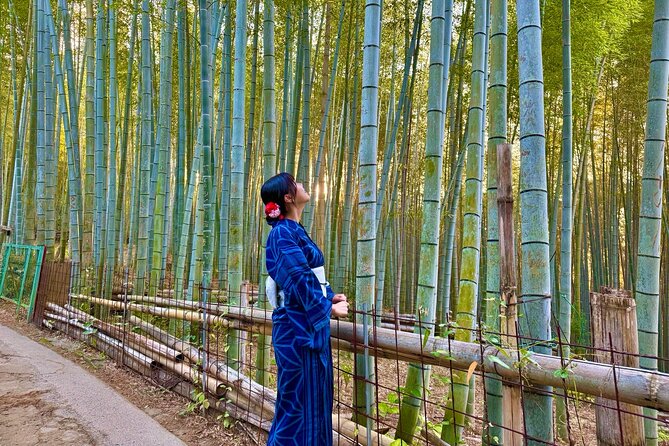
Next up: Sannenzaka and Ninenzaka, two charming lanes paved with stone and lined with traditional wooden buildings. This is one of the easiest parts of the itinerary to enjoy at an unhurried pace, because it’s basically a walk through old Kyoto with shops and snack options.
You’ll have about 15 minutes here. Admission is free, and the value is in the atmosphere: you’ll see souvenir shops and restaurants tucked into the historic street look, and it helps break up the heavier “big landmark” rhythm.
A realistic expectation: 15 minutes goes fast. This is a “wander and glance” window, not a shopping spree. If you’re the type who needs time to try food or browse, consider saving the longer browsing for after the tour when you’re done with the guided schedule.
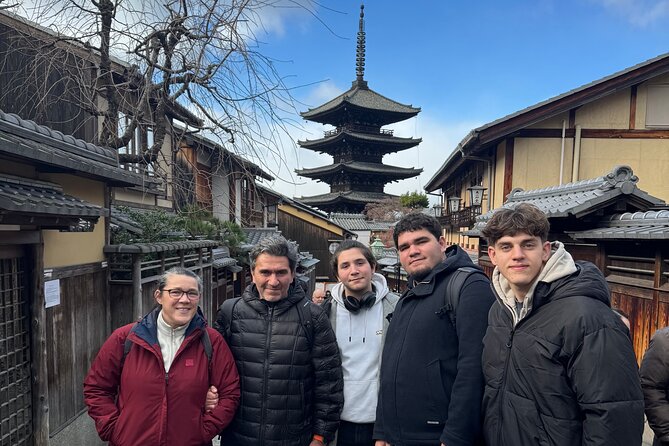
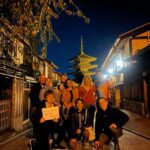
Stop 4: Yasaka Pagoda (Hokanji) and its nail-free legend
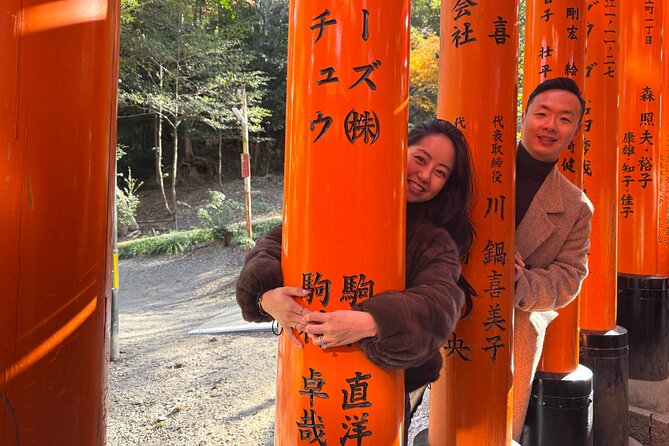
Yasaka Pagoda is listed as Yasakanoto (Hokanji temple), with about 15 minutes on the stop. Admission is free. The standout detail: it’s one of Japan’s oldest wooden structures, and it’s famous for the scale people find hard to believe was built without nails.
This is also a great reset moment. After walking through large sight areas, you get a shorter cultural stop where the guide can explain why the structure matters and what to pay attention to when you’re looking at old wood architecture.
And since the time is short, you don’t feel like you’re sacrificing too much energy just to check off another temple. Think of it as a meaningful photo-and-stare break.
More evenings along the lantern-lit lanes of Gion

Stop 5: Yasaka Koshin-Do and its colorful contrast
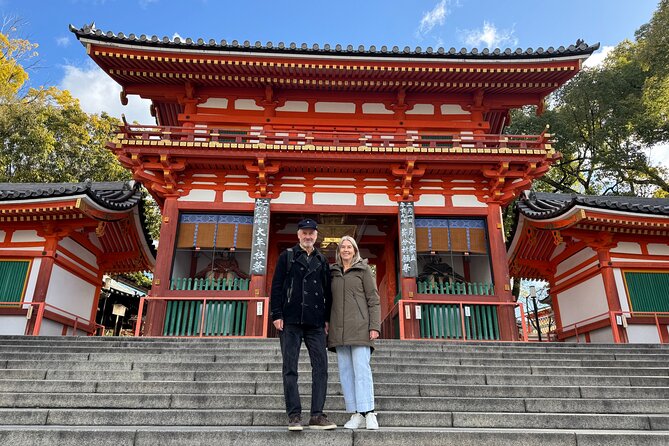
Right after the pagoda, you’ll visit Yasaka Koshin-Do, also for about 15 minutes. This one is described as mysterious, with a construction date that isn’t clearly known. What draws your eye immediately is the decoration style—many temples tend toward subdued colors, but this one is known for striking color work.
Admission is free, so this is mostly about attention. If you’re a detail watcher, you’ll probably enjoy this stop more than you expect, because colorful temple decorations can feel like visual storytelling once you understand what the setting is for.
If you’re not a details person, don’t worry. The guide should still give you something concrete to notice so you’re not just walking past color without context.
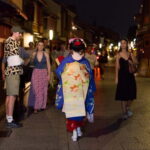
Stop 6: Gion’s traditional streets and geisha district atmosphere
Then comes Gion, Kyoto’s best-known geisha district. You’ll get about 15 minutes in this area, also with free admission.
This stop is about the street vibe: traditional machiya houses, teahouses, and preserved historic streets. It’s not designed as a long “go window-shop for hours” segment. It’s a quick, high-impact introduction to why this district feels different from other Kyoto neighborhoods.
Here’s what you can do with the time: focus on walking and observation. Look at the building shapes, the street layout, and the way the historic architecture holds the atmosphere. If you want more time for photos or shopping, plan to extend your walk after the tour ends at Yasaka Shrine.
Stop 7: Yasaka Shrine, the bigger network behind one main shrine
The tour ends at Yasaka Shrine, with about 30 minutes allotted. Admission is free.
This is more than a final scenic stop. The shrine is described as the headquarters of 2,300 related shrines across Japan. If you like understanding the bigger picture behind religious sites, this is the kind of fact that can turn a “pretty stop” into a “now I get it” stop.
Since the tour finishes here, it’s also a practical advantage. You can keep walking in the Gion area, or you can ask your guide what route makes the most sense next based on where you want to go.
Why the guides make (or break) the experience
The best praise in the reviews centers on the guide experience, especially Ikki. What people repeatedly highlight is not just English ability, but clarity and confidence—being able to explain what you’re seeing at each shrine and temple in a way that makes the place feel understandable instead of confusing.
Another standout: photo-taking. The tour includes professional photos during the tour, and multiple people mention how Ikki took lots of pictures that they wouldn’t have managed on their own. That matters because Kyoto’s sights are photo-heavy, but good photos often require timing and angles—especially early in the day when you’re still catching the locations at their best.
There’s also mention of extra teaching style details. One guest specifically noted a booklet with pictures and guidance that helped with language, temple and shrine context, and even how to participate in prayers. Whether you care deeply about that or just want to feel more oriented, it’s a real upgrade from a simple “here’s the landmark” walk.
One more thing: the guide is repeatedly described as polite, patient, and easy to talk to. That matters for families too. One review mentions an 8-year-old, and the tone suggests the guide adjusted to the group so the kid wasn’t dragged through everything like a museum chore.
Price and logistics: what you really pay for
The tour is priced at $99.10 per person. For that, you get an English-speaking local guide, the stop sequence across major landmarks, and professional photos taken during the tour. You also get a mobile ticket, and the tour is private for your group.
But two costs are clearly listed as not included:
- Public transportation fare: ¥390 per person
- Kiyomizu-dera admission: ¥500 per person
Food and drinks are not included.
So the real value calculation is: you’re paying for guide time and photo support across multiple stops, plus a route that compresses Kyoto’s top hits into one morning plan. If you’re comfortable navigating on your own, you might spend less money. If you want your time protected—less transit figuring-out and more direct sightseeing—this price can feel fair fast.
Group discounts are mentioned too, which can make the math even nicer if you’re traveling with friends or family.
Timing reality: 4 to 5 hours, but plan like it might be shorter
The tour description says 4 to 5 hours (approx.). Yet at least one guest reported it felt shorter, around 2.5 hours. That doesn’t automatically mean something went wrong. Tours can run faster if the group pace is smooth, if time at each stop is naturally efficient, or if crowds are unusually light.
My practical advice: think of it as a morning-to-early-afternoon block you can flex. If you have a hard reservation right after, keep some buffer. Wear shoes you can walk in for a few hours. And bring water, because walking in Kyoto adds up quickly even on a “highlights” route.
Who this Kyoto early-bird tour fits best
This is a strong match for:
- First-time Kyoto visitors who want a concentrated highlights route with real explanations.
- Couples and small groups who value photo support and a guided flow.
- Families who want a structured experience without feeling stuck in a single location.
- People who want less crowd stress, since the early start is built around seeing key spots before it gets too heavy.
If you love slow museum-style wandering and don’t want any schedule structure at all, you might find the stop times a bit tight. But if your goal is to see Kyoto’s big icons with guidance and photos, it’s a sensible plan.
Should you book this Kyoto Early Bird English Tour?
Yes—if you want a guided highlights morning that covers the most famous Kyoto stops in a logical order and includes professional photos. The guide quality seems to be the biggest differentiator, with Ikki specifically praised for clear English, thoughtful pacing, and being genuinely easy to ask questions.
Book it especially if:
- you’d rather pay a fair price than spend your morning solving transit and entry logistics,
- you care about understanding shrines and temples instead of just taking pictures,
- you like the idea of ending in the Gion area so your day doesn’t feel like it ends abruptly.
Skip it (or at least rethink it) if:
- you’re trying to avoid any admission fees and transit costs beyond the base price,
- you want lots of free time inside each site for long shopping or sit-down meals.
Bottom line: this tour is built for efficiency with a human touch. The early timing helps, and the photo-and-explanation approach makes the landmarks stick in your memory.
FAQ
How long is the Kyoto Early Bird English Tour?
The duration is listed as about 4 to 5 hours, and it’s designed as a walking experience using public transportation and time on foot.
What is included in the tour price?
Included are an English-speaking local guide and professional photos taken during the tour. A mobile ticket is also mentioned, and it’s private for your group.
What extra costs should I expect?
Public transportation fare is listed as ¥390 per person. Kiyomizu-dera admission is ¥500 per person and is not included. Food and drinks are also not included.
Where does the tour start and end?
It starts at Kyoto Station (Higashishiokoji Kamadonocho, Shimogyo Ward) and ends at Yasaka Shrine in the historic Gion area (625 Gionmachi Kitagawa, Higashiyama Ward).
Is the tour a walking tour?
Yes. It’s designed as a walking experience with plenty of time on foot. A moderate physical fitness level is recommended.
What’s the cancellation policy?
Free cancellation is available if you cancel up to 24 hours in advance for a full refund. If you cancel less than 24 hours before the start time, the amount you paid is not refunded.
More Tour Reviews in Kyoto
Still in Gion? Keep Going
Fushimi Inari, a Few More Ways
Just added: more Kyoto tours to browse





Fushimi Inari Shrine Tours, compared.
 ★ 4.8Fushimi Inari, Kinkakuji, Bamboo Grove 1 Day Bus TourFrom $1224,316 reviews
 ★ 5.0Fushimi Inari Hidden Hiking Tour (Private Option Available)From $631,750 reviews
 ★ 4.7Kyoto/Osaka: Nara, Fushimi Inari Taisha, Arashiyama Bus TourFrom $521,275 reviews
 ★ 4.4Osaka/Kyoto: Arashiyama, Nara & Fushimi Inari Shrine w/LunchFrom $61754 reviews
 ★ 4.7Nijo Castle, Kiyomizu & Fushimi Inari Guided TourFrom $54700 reviews
 ★ 5.0Nijo, Kinkaku-ji, Arashiyama, Kiyomizu & Fushimi InariFrom $51699 reviews
 ★ 5.0Kyoto Fushimi-Inari Night Walking TourFrom $43320 reviews
 ★ 4.93-Hour Fushimi Inari Shrine Hidden Hiking TourFrom $72270 reviews
Browse the lists this tour appears in