
Reviewed · GION & GEISHA DISTRICT TOURS
Dance and Game with Maiko
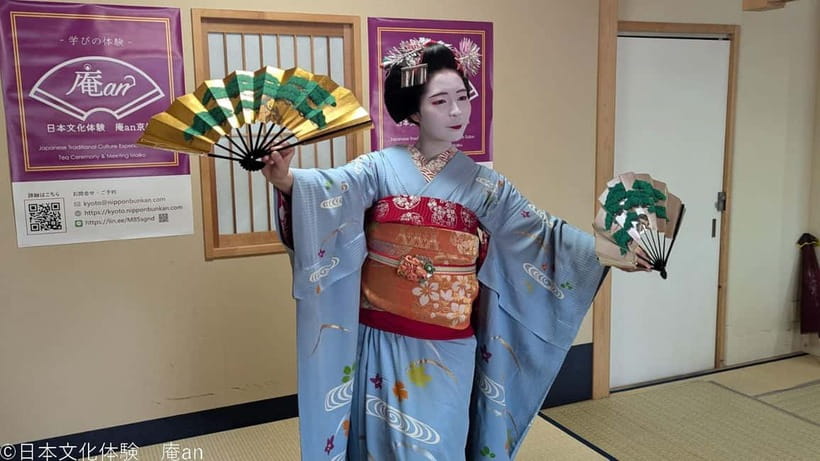
A Maiko dances right next to you. In Kyoto, this short show pairs two up-close dances with a Maiko photo and a lucky charm, so you get the vibe without clearing your entire day. The main catch: it is held in a regular building (not a classic ochaya setting), and timing can feel closer to 30 minutes once you’re inside.
What I like most is the personal feel. You’re close enough to actually notice how controlled the movement is, and the game keeps the mood light. Just note the venue has no elevator, so plan on stairs and shoes you can trust.
In This Review
- Key highlights worth your attention
- Why this Maiko show works when your Kyoto day is already packed
- Getting there near Gojo Station, and what to expect from the venue
- The program flow: what you’ll do for those 45 minutes
- Watching two Maiko dances up close (and how to get the most out of them)
- The game with the Maiko: fun, simple, and best when you’re comfortable participating
- Photo time and the Senjafuda lucky charm
- When it is shorter than expected, or when you meet Geiko instead
- Price and value: is $28 a smart buy?
- Who should book this, and who should choose something else
- Practical tips so you enjoy it without stress
- Should you book Dance and Game with Maiko?
- FAQ
- How long is Dance and Game with Maiko?
- Where is the meeting point?
- What is included in the price?
- Is tea ceremony included?
- Do I need special preparation?
- Are there English translations?
- Will it always be a Maiko?
- Is there an elevator at the venue?
- What about children?
- What happens if I’m late?
Key highlights worth your attention
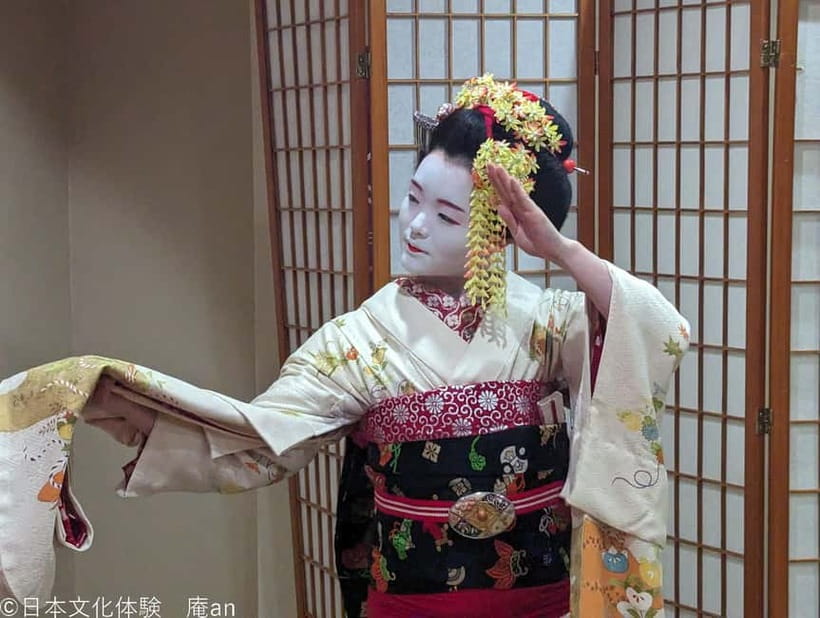
- Two Maiko dances that move through seasonal and everyday themes, not just one routine
- Photo time up close, positioned like a real keepsake moment rather than a quick photo line
- A lucky charm (Senjafuda) handed to you at the end, easy to take home
- A traditional game with the Maiko, with audience participation encouraged
- A compact program window (45 minutes scheduled, often shorter in practice) that fits busy Kyoto days
Why this Maiko show works when your Kyoto day is already packed
Kyoto can swallow your schedule fast. Temples take time, streets take time, and suddenly you’re staring at an empty dinner reservation and wondering how you’ll fit one more cultural thing in. This experience is designed for that exact problem: it’s short, it’s structured, and it delivers what most people come to Kyoto hoping to see.
You get a concentrated look at Maiko performance, with two separate dances rather than a single set. Even if you only understand a little Japanese, the storytelling comes through in the posture, the pacing, and the way each dance ties back to everyday life and seasonal scenes. I like that the program doesn’t feel like a museum talk; it feels like watching an active art in real time.
The show also gives you an easy souvenir moment. A lot of Kyoto culture tours stop at photos from a distance. Here, you’re invited into the memory-making part: a commemorative photo and the Senjafuda charm.
Possible drawback: because it’s a compact format, you should treat it as a “taste,” not a full-length immersion. If your heart is set on a longer, deeper traditional experience, you’ll likely want a tea ceremony program instead.
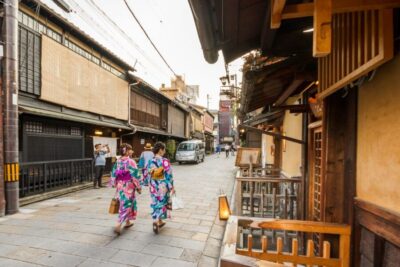
More evenings along the lantern-lit lanes of Gion


Getting there near Gojo Station, and what to expect from the venue
The meeting point is simple: it’s about a 1-minute walk from Exit 1 of the Karasuma Line Gojo Station. The shop entrance faces Gojo-dori (main street), so you’re not hunting through a maze of side lanes. If you’re already in central Kyoto, this is one of those activities that doesn’t fight you.
The venue is in a building and that matters. There’s no elevator, so you’ll need stairs to reach the rooms. If you’re traveling with heavy bags, limited mobility, or you’re wearing shoes that don’t like stairs, factor that into your timing. Also plan to arrive a few minutes early so you’re not rushed while climbing up.
Another practical note that helps set expectations: this is not an ochaya or a traditional Japanese house. It’s a dedicated room setup that aims for a relaxed experience, with friendly staff. That’s good news if you’re worried you’ll feel out of place. You don’t need special preparation.
On the language side, English support is provided as much as possible. The instructor is Japanese, and English translation can be added if you contact them. If you want the smoothest experience, it’s smart to mention any translation needs ahead of time rather than hoping for everything at the door.
The program flow: what you’ll do for those 45 minutes
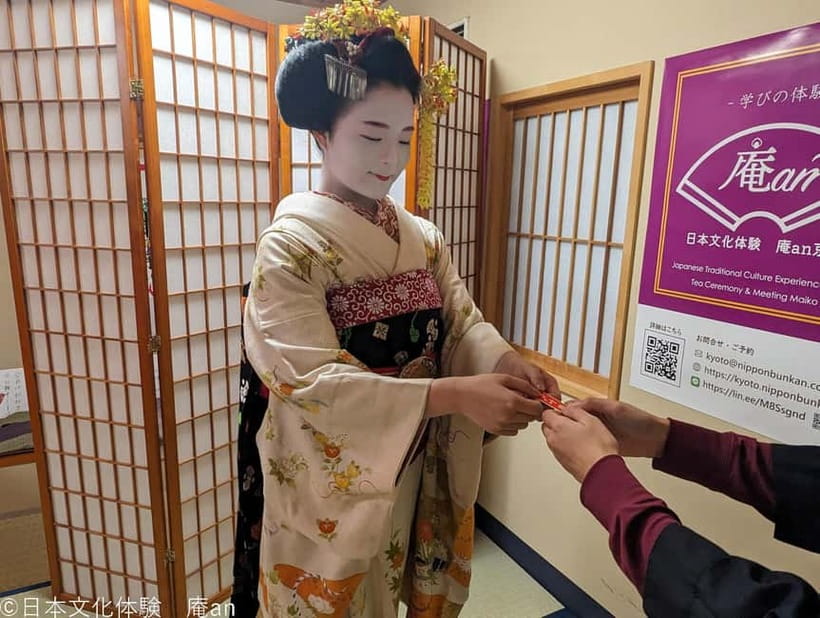
The schedule is compact, and it moves like a show. In most cases, the format is roughly: program start, Maiko dance, game, photo, then the Senjafuda presentation. After that, there’s time to chat before you head out.
Depending on the timing of the day, it may run alongside guests who are having lunch or dinner. That usually means the room has an active, social energy, not a silent ceremonial atmosphere. Don’t expect “library quiet.” Expect friendly noise and shared attention.
Also, the booking window is 10:00 to 17:00, and reservations received after 17:00 are processed the next day. If you’re trying to build a schedule tightly around this, pick a time that gives you a cushion for getting there and finding the entrance.
One more realistic expectation: while the experience is listed at about 45 minutes, the time you feel in the room can be shorter. My advice is to plan for the experience to be around 30 minutes of actual “activity,” then allow a bit of buffer around arrival and the wrap-up.
Watching two Maiko dances up close (and how to get the most out of them)
The heart of this activity is the two elegant Maiko dance performances. What I love about having two dances is contrast. The first sets the mood, and the second gives you another lens on how Maiko performance can shift through theme, rhythm, and expression.
The dances are described as portraying scenes from Japan’s seasons, love stories, and everyday life. You don’t need to know every word or label to feel the difference. Watch for how the movement tells the story. Maiko dance isn’t just graceful; it’s controlled. Arms, wrists, and footwork all land with intention, and the changes are often more obvious than the plot.
Photo-wise, you’re encouraged to capture the moment. The biggest practical tip: be ready before the dance starts. If you spend the first minute hunting for your camera setting, you miss the first clean shots. Also, keep your expectations reasonable. This is a close experience, but it’s still a performance space with a group around you, so be respectful of space and timing.
If you’re the type who wants to understand what you’re seeing, this is where translation support matters. Even small explanations can help you connect gesture to theme.
The game with the Maiko: fun, simple, and best when you’re comfortable participating
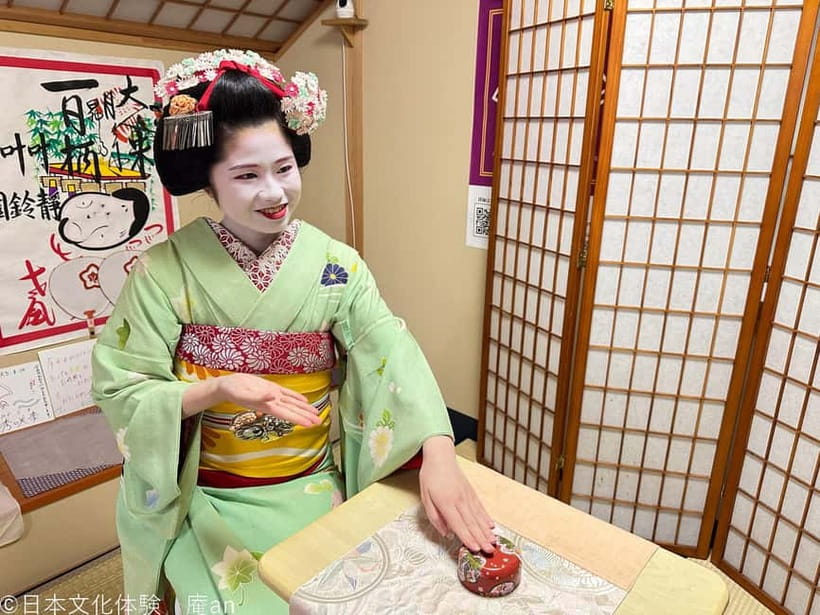
After the dances, the program shifts gears into a traditional game played between the Maiko and guests. It’s described as simple, exciting, and interactive. Volunteers from the audience are invited to play with the Maiko, and you can clap and cheer along.
This is the part that makes the whole experience feel less like theater and more like participation. It’s also the part that can be a little awkward if you’re shy in a room full of strangers. If you want to maximize your comfort, go in with a mindset of light participation rather than performance pressure.
A useful reality check: kids sometimes feel embarrassed to join in front of a group. If you’re traveling with children and they’re quiet types, it may help to talk with them beforehand: the goal is fun, not winning. If they still prefer to watch, check the rules with the provider first, because they state those who do not participate in the experience will not be allowed to enter. That doesn’t necessarily mean every person must be a game player, but it does mean they expect engagement with the activity.
If you’re an adult, the game is often what turns a “seen it” moment into a “we did it” memory. The energy in the room tends to lift quickly once people realize it’s meant to be cheerful.




Photo time and the Senjafuda lucky charm
Right after the game, you’ll get your chance to take photos right beside the Maiko. This is a key value point. Many Kyoto experiences offer photos from a polite distance. Here, the photo moment is built into the flow, and it’s positioned as a commemorative memory.
Then comes the keepsake: the Maiko gives you a small lucky charm called a Senjafuda. It’s small, but that’s part of the charm. You don’t need a special display shelf to appreciate it—you can carry it, keep it as a pocket reminder, or tuck it into a travel journal.
I like that the charm ties the experience into a “finish” moment. It turns the show into something you can take away, instead of only living in your phone photos.
When it is shorter than expected, or when you meet Geiko instead
Two timing things can affect your expectations.
First: the program duration is listed around 45 minutes, but in practice you may feel closer to 30 minutes once the room is moving through each segment. The best way to handle this is to schedule it when you’re not racing to the next reservation immediately after. Treat it like a middle-of-the-day cultural stop rather than a final-second add-on.
Second: the experience says that depending on the situation, they may invite Geiko instead of Maiko. Kyoto’s performing arts world has its own dynamics, and you’re still likely to get a polished dance performance and the same overall structure. If you specifically want Maiko only, you should message the provider in advance and ask what’s most likely for your date and time.
These two factors aren’t dealbreakers. They just help you plan your day with the right level of flexibility.
Price and value: is $28 a smart buy?
At $28 per person for a program near Gojo Station, the value comes from compression and access.
You’re not paying for a long multi-hour tour that risks being diluted by transit time. You’re paying for:
- Close access to dance performance and a personal photo moment
- A souvenir (Senjafuda) that you receive as part of the program
- A chance to participate in a traditional game, which many Kyoto experiences keep at a distance
If you compare this to longer cultural programs, the cost can look low because the time is shorter. But you’re also getting a focused set of highlights: two dances, interactive game time, photo time, and the charm.
When $28 feels like a good deal: if you’re in Kyoto for a limited time, you want one tangible Maiko moment, and you don’t want to commit to a longer tea ceremony schedule. If you’re expecting a deep, extended explanation of every dance element, you may feel you want more time. In that case, it’s better to pair this with another cultural activity that offers longer context.
Who should book this, and who should choose something else
This experience is a strong fit if you:
- Want a short Kyoto cultural stop that won’t crush your itinerary
- Care about photo access and a hands-on souvenir moment
- Like the idea of a performing arts program that also includes interaction
It may be less ideal if you:
- Need step-free access, since there’s no elevator and you’ll use stairs
- Want a silent, highly traditional ochaya-style setting (this is a building venue)
- Want a long sit-down tea ceremony format, which is offered as separate programs instead
For families: children under 2 are free if they sit on your lap. If your child wants to participate, the game element can be fun, but shyness is real—especially in front of people. If your child is likely to freeze, it’s worth choosing a format that doesn’t put them on the spot.
Practical tips so you enjoy it without stress
A few small things help you get the most out of this experience:
- Arrive a few minutes early so you can handle stairs calmly and still be seated when the show starts. They don’t accommodate delays.
- Bring a fully charged camera. The dances move quickly, and photo time comes right after the game.
- Wear comfortable shoes. You’ll likely be stepping and moving in a room setting, plus stairs to reach the venue.
- If you prefer English support, consider contacting the provider in advance to request translation assistance.
- Keep your day flexible right after. If the program feels shorter than expected, you’ll have an easier time adjusting.
Should you book Dance and Game with Maiko?
Book it if you want a real Kyoto-performing-arts moment that fits into a tight schedule. For many first-timers, this hits the sweet spot: two dances you can actually see up close, a playful traditional game, a photo beside the Maiko, and a Senjafuda charm you can keep.
Skip or reconsider if you’re searching for a full, deep traditional setting like an ochaya tea-focused experience, if stairs are a challenge for you, or if you’re hoping for a purely observational show. In those cases, a different Maiko-focused program—or a longer tea ceremony—may suit you better.
If your plan includes Kyoto highlights and you still want one experience that feels personal, this one is worth your time.
FAQ
How long is Dance and Game with Maiko?
The experience is scheduled for about 45 minutes. It’s also possible the time felt in the room is shorter depending on the flow of the day.
Where is the meeting point?
Meet 1 minute walk from Exit 1 of the Karasuma Line Gojo Station. The store entrance faces Gojo-dori.
What is included in the price?
The price includes the Maiko dance performances, the traditional game with the Maiko, the photo opportunity beside the Maiko, and the Senjafuda lucky charm.
Is tea ceremony included?
No. If you want a tea ceremony with Maiko, there are separate programs: Tea ceremony with Maiko or Tea ceremony with Maiko premium.
Do I need special preparation?
No special preparation is required. The atmosphere is described as relaxed, and you can join without concerns.
Are there English translations?
English translation is provided as much as possible. If you would like to add English translation, you should contact the provider.
Will it always be a Maiko?
Depending on the situation, Geiko may be invited instead of Maiko.
Is there an elevator at the venue?
No. There is no elevator, and you will need to take stairs to reach the venues.
What about children?
Children under 2 years old are free if they sit on their parents’ laps. If a seat or meal is required for a child under 2, the same fee as one person will be charged.
What happens if I’m late?
The event cannot be held to accommodate delays, and they charge a cancellation fee according to the cancellation policy if you cancel. Also, in cancellation situations they do not compensate travel expenses.
More Tour Reviews in Kyoto
Still in Gion? Keep Going



Just added: more Kyoto tours to browse








Gion & Geisha District Tours, compared.
 ★ 4.7Kyoto Geisha Walking Tour: Gion District & Hidden GemsFrom $253,273 reviews
 ★ 4.9Gion Magical Night Walking Tour with Geisha TriviaFrom $242,393 reviews
 ★ 4.7Gion Geisha District Walking Tour – Stories of GeishaFrom $202,187 reviews
 ★ 4.9Best of Kyoto: Gion, Geisha, Pagodas & CobblestonesFrom $242,058 reviews
 ★ 4.5Night Walk in Gion: Kyoto’s Geisha DistrictFrom $212,003 reviews
 ★ 5.0Kyoto Night Foodie Tour in Gion (9+ dishes + 6 Sake tastings)From $1631,762 reviews
 ★ 5.0Kyoto Gion Geisha District Walking Tour – The Stories of GeishaFrom $251,441 reviews
 ★ 5.0Kyoto Gion: 2-Hour Geisha Culture & History Walking TourFrom $231,186 reviews
Browse the lists this tour appears in