
Reviewed · FUSHIMI INARI SHRINE TOURS
Kyoto & Nara Day Tour: Golden Pavilion, Fushimi Inari & Deer Park
Kyoto in one day can feel rushed, yet this route is tightly planned and packed. I like how the day pairs signature icons with a calmer stretch in Arashiyama, so your photos and your mood both get a break. You also get skip-the-line help for major stops like Kinkaku-ji and Fushimi Inari.
Two things I really like: first, the Golden Pavilion at Kinkaku-ji is timed well, so you can enjoy the pond reflections and the Zen gardens without feeling chased. Second, the Nara portion is built around the deer experience, plus Todai-ji’s massive Buddha, which is exactly the kind of wow moment most people remember for years.
One drawback to plan for: seasonal and holiday conditions can change what you can access. The tour specifically notes that Fushimi Inari may be affected during year-end and New Year’s traffic restrictions, and in general, long-day tours can feel less flexible if your priorities hinge on one single stop.
In This Review
- Key highlights you’ll feel from the start
- A full Kyoto and Nara day in 10–11 hours (and why that matters)
- Golden Pavilion at Kinkaku-ji: how to use 40 minutes well
- Fushimi Inari’s torii tunnels: timing, crowds, and the halfway viewpoint
- Arashiyama bamboo forest in 40 minutes: calm, light, and quick photos
- Tenryū-ji temple gardens and Togetsu-kyo Bridge views
- Nara Deer Park and Todai-ji: the moment the day clicks
- Skip-the-line and tickets: where the tour actually saves time
- Price and value: is $93 worth it for this route
- Communication and guide behavior: what to watch for
- Who this tour suits best (and who should skip it)
- Should you book this Kyoto and Nara day tour?
- FAQ
- How long is the Kyoto & Nara Day Tour?
- Where does the tour depart?
- What is the price per person?
- What’s included in the tour price?
- Which admissions are included for the attractions?
- Is Fushimi Inari always visited?
- Do I need to arrive early?
- How big is the group?
Key highlights you’ll feel from the start
- Kinkaku-ji Golden Pavilion with admission included and a focused 40-minute visit
- Fushimi Inari Taisha torii-gate hiking with admission included, plus a mid-route view payoff
- Arashiyama bamboo forest and Tenryū-ji as a quieter natural/Zen reset
- Togetsu-kyo Bridge for classic Katsura River views in a short window
- Nara Deer Park with deer-feeding crackers and a 1,000+ deer atmosphere
- Todai-ji Temple included in the Nara experience, famous for the world’s largest bronze Buddha
A full Kyoto and Nara day in 10–11 hours (and why that matters)
This is a long day: plan on about 10 to 11 hours from departure to return. The pacing is designed around big-name sites, with the remaining time acting as transfer buffers between stops, so you’re not constantly sprinting between locations.
The day starts with a meeting/greeting at the Kyoto VIP Lounge and a departure at 09:00 AM from VIP Villa Namba. The tour runs in a smallish group, with a maximum of 40 travelers, and you travel by air-conditioned vehicle (the exact vehicle type depends on group size).
For me, the big value isn’t just seeing places. It’s getting the order and timing right when you have limited time in Kansai. If you want a “greatest hits” day that still has moments to breathe, this fits well.
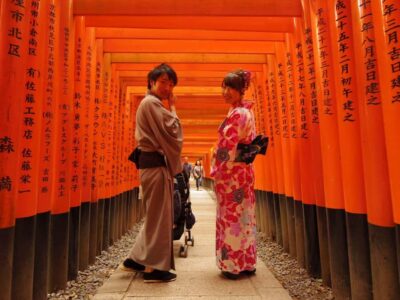
More walks up through the vermilion torii of Fushimi Inari

Golden Pavilion at Kinkaku-ji: how to use 40 minutes well
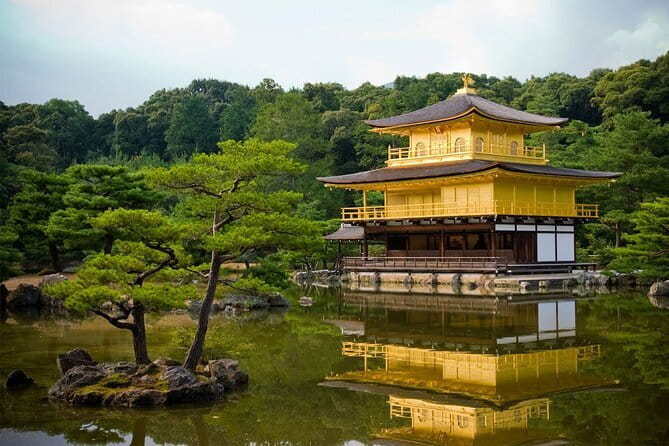
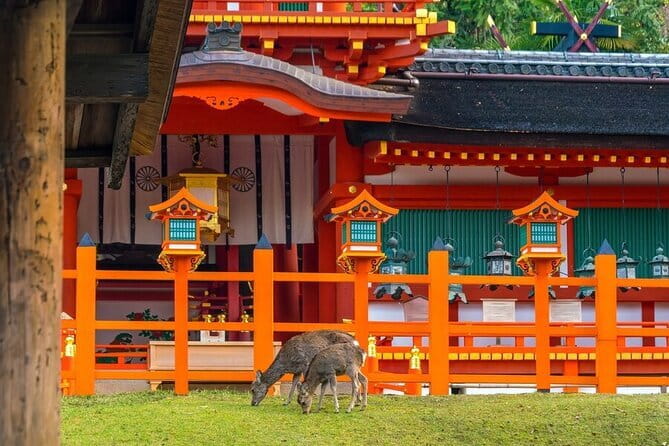
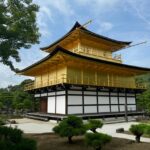
Kinkaku-ji, the Golden Pavilion, is one of those Kyoto sights that looks like a postcard in real life. The upper floors are covered in gold leaf, and the mirror-like pond around it turns the scene into a bright reflection trick—especially when the light is even and calm.
You get about 40 minutes here, and that time is just enough to do three things without rushing: see the pavilion from the right angles, walk through the Zen-style garden paths, and take in the details like the small stone pagodas and koi-filled ponds. There’s even mention of a small tea house, which is perfect if you want one quiet pause before the day heats up again.
Practical tip: go slow the first time you’re near the pavilion. The garden views and reflection points are where the magic lives, not just the pavilion itself.
Fushimi Inari’s torii tunnels: timing, crowds, and the halfway viewpoint
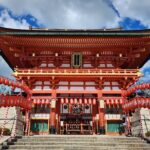
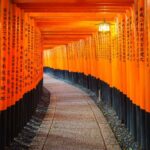
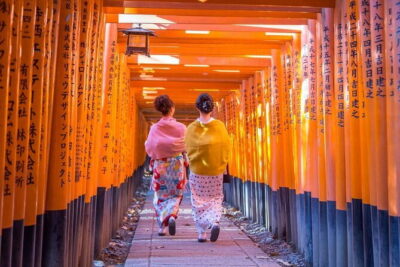
Fushimi Inari Taisha Shrine is famous for its thousands of red torii gates that create tunnel-like paths through the hillside. The shrine is dedicated to Inari, the Shinto deity tied to rice, prosperity, and business, and the route reflects that sacred rhythm with lots of smaller shrines along the way.
You’re scheduled for about 1 hour 20 minutes at Fushimi Inari, with admission included. That’s enough time to walk beyond the first rush, notice the stone fox statues (Inari messengers), and still make it to the halfway point for panoramic views over Kyoto.
Here’s the key consideration: this stop can be affected around year-end and New Year’s holidays due to traffic restrictions. If these dates are on your calendar, I’d treat Fushimi as a best-case scenario and be flexible in your expectations.
Practical tip: wear shoes you can hike in comfortably. Even though it’s not a mountain trek, the stairs and slopes add up, especially in the middle of a long day.
Arashiyama bamboo forest in 40 minutes: calm, light, and quick photos
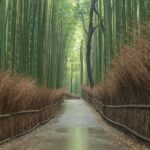
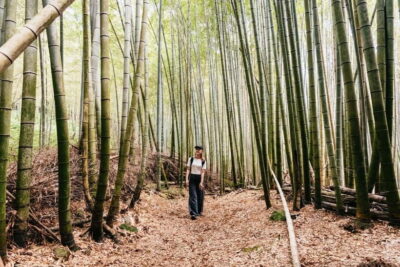
After the intensity of the torii gates, the Arashiyama Bamboo Forest works like a reset button. You walk along winding paths surrounded by towering bamboo stalks, and the movement of the plants makes the whole place feel alive even when it’s quiet.
You get about 40 minutes here, and it’s a smart length. You can experience the “light and shadow” effect as sunlight filters through the bamboo, take photos from a few angles, and still not feel trapped in a never-ending crowd flow.
This is also a good place to slow down because the pace is different from the shrine areas. If your goal is more than selfies—if you want a moment to breathe—this stop helps.
Tenryū-ji temple gardens and Togetsu-kyo Bridge views
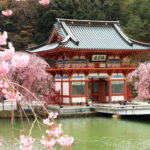
Right after bamboo, you visit Tenryū-ji Temple for about 40 minutes. It’s a major Zen Buddhist temple and a UNESCO World Heritage Site, known for its garden setting built around the surrounding Arashiyama mountains. Expect a pond view, carefully arranged rocks, and maintained greenery that’s meant for quiet looking rather than fast sightseeing.
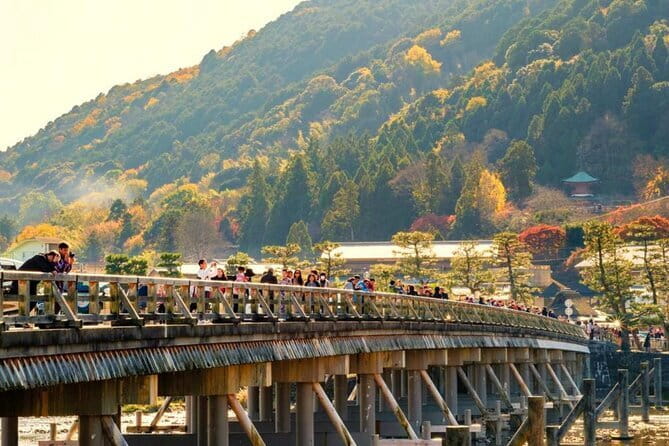
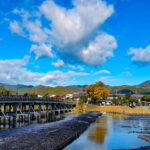
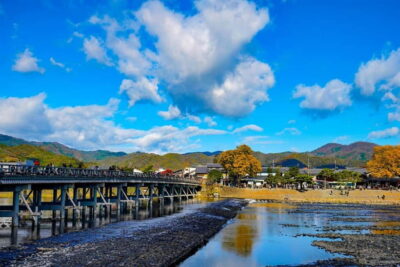
Then you cross Togetsu-kyo Bridge for around 20 minutes. The bridge spans the Katsura River and gives classic seasonal views—cherry blossoms in spring, and red/orange foliage in autumn, if you’re there during those times.
This pair (Tenryū-ji + Togetsu-kyo) is a practical win because it gives you both a still, garden-focused experience and a moving river view, without forcing you to commit to a long hike. In a day this long, that balance matters.
More gilded pavilions and raked gardens around Kyoto

Nara Deer Park and Todai-ji: the moment the day clicks
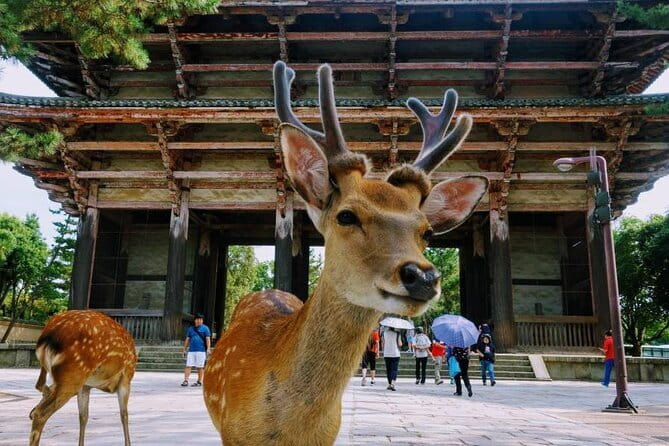
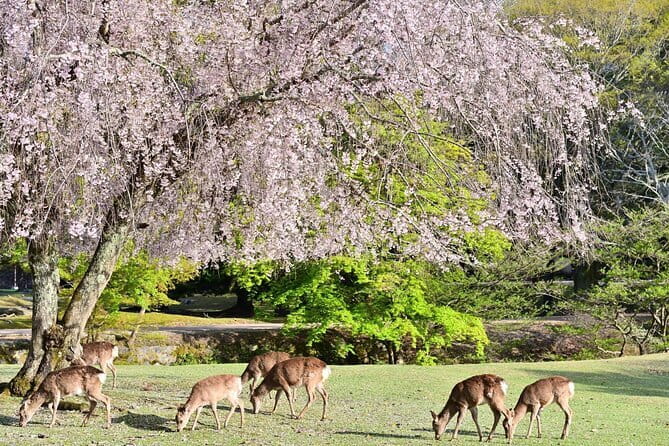
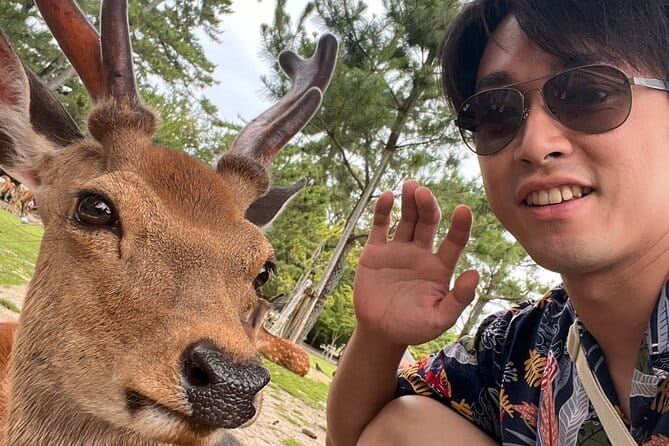
The Nara portion starts at Nara Deer Park, with about 1 hour 20 minutes planned. This is one of the most distinctive parts of the day: you’ll see 1,000+ free-roaming deer that are treated as sacred messengers in Shinto belief.
You can buy shika senbei (deer crackers) to feed them, and the experience gets lively fast. The deer are curious and sometimes bold, and they can bow before taking crackers. It’s fun for kids, but adults often get just as pulled in because it feels real and un-scripted.
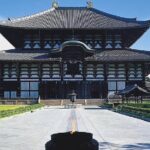
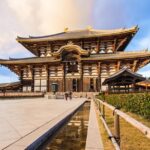
Nara’s “big moment” also includes Todai-ji Temple, known for housing the world’s largest bronze Buddha. Even if you’re not a history nerd, that scale is hard to ignore. It’s the kind of cultural anchor that makes the day feel more than just a photo tour.
Practical tip: be ready for deer attention near the snack time. Keep your hands controlled and follow the flow rather than fighting it.
Skip-the-line and tickets: where the tour actually saves time
This tour includes admission for Kinkaku-ji Temple, Fushimi Inari Taisha Shrine, and Nara Deer Park. It also includes professional English guidance, plus round-trip transportation in an air-conditioned vehicle.
Why does that matter? Because the long lines at major Kyoto landmarks can eat your day. When you’re working with 10–11 hours total, saving 30–60 minutes in the wrong place can mean you miss a key viewpoint later.
The Arashiyama bamboo forest, Tenryū-ji, and Togetsu-kyo Bridge have free admission listed, but they’re still scheduled tight. So the real time-saving is most meaningful for the stops with included entry—especially Kinkaku-ji and Fushimi Inari.
Also note the tour’s structure: you’ll have transport time plus the scheduled attraction blocks, and the remainder of your day is basically transfer time. If you’re the type who likes long, slow breaks, you might feel a little compressed.
Price and value: is $93 worth it for this route
At $93 per person, this tour prices itself as a midrange day trip that combines transportation, a guide, and multiple paid attractions. The math works best if you want a guided, organized route rather than stitching together trains and entry lines yourself.
What you’re paying for:
- Round-trip AC transport
- Professional English-speaking guide
- Admission tickets for key sites (Kinkaku-ji, Fushimi Inari, Nara Deer Park)
What can cost extra:
- Drinks and meals (not included)
- Personal expenses
So is it good value? For most people, yes—because it’s a lot of “must-see” territory packed into one coherent day. The trade-off is flexibility. If your trip needs more downtime or you want to linger longer at only one site, a self-guided approach might feel better, even if it costs more effort.
Communication and guide behavior: what to watch for
Most days like this rise or fall on the guide’s ability to keep timing smooth. The tour is set up for a managed group flow, and you’re encouraged to arrive early (around 10 minutes before departure) so the schedule starts clean.
I’d also pay attention to communication style. There are reports of the guide using WhatsApp for quick confirmations and instruction sharing, and that can be genuinely helpful when you’re moving between different locations in a single day.
One caution from real-world experiences: a small number of people reported rude or unpleasant guide interactions and seat-related conflicts. I can’t predict how your guide will be, but if you care about comfort—like front-row seating or needing clear, calm directions—I’d state your needs upfront at check-in and be ready to address issues immediately if something feels off.
Who this tour suits best (and who should skip it)
This fits best if you:
- Want Kyoto and Nara in one day without transport headaches
- Like structured sightseeing with a guide
- Care about the big-name sites: Golden Pavilion, Fushimi Inari, bamboo in Arashiyama, and Nara deer plus Todai-ji
You might think twice if you:
- Plan to travel during year-end/New Year’s periods, when Fushimi Inari could be impacted
- Hate tight timing and prefer long pauses at fewer places
- Are sensitive to group dynamics and guide tone
If your goal is an efficient “greatest hits” day with a few calmer nature/Zen moments, this delivers more often than it disappoints.
Should you book this Kyoto and Nara day tour?
Book it if you want a guided, ticketed day that hits the essentials with less planning stress. The strongest case is the pairing of Kinkaku-ji and Fushimi Inari (both with included entry support), plus the contrast of Arashiyama’s bamboo calm and Nara’s deer-and-Buddha wow factor.
Hold off or confirm details closely if your dates fall during year-end and New Year’s, since the tour notes potential traffic restriction impacts for Fushimi Inari. Also, if you’ve got strict preferences about pacing or seating, message the operator ahead of time so expectations are clear.
FAQ
How long is the Kyoto & Nara Day Tour?
It runs about 10 to 11 hours total.
Where does the tour depart?
The tour departs at 09:00 AM from VIP Villa Namba, and guests from Kyoto are greeted at the Kyoto VIP Lounge.
What is the price per person?
The price is $93.00 per person.
What’s included in the tour price?
Included are round-trip transportation in an air-conditioned vehicle, admission for Kinkakuji Temple, and a professional English-speaking guide.
Which admissions are included for the attractions?
Admission tickets are included for Kinkakuji Temple, Fushimi Inari Taisha Shrine, and Nara Deer Park. Arashiyama Bamboo Forest, Tenryū-ji Temple, and Togetsu-kyo Bridge are listed as free admission.
Is Fushimi Inari always visited?
Not necessarily. The tour notes that due to traffic restrictions during year-end and New Year’s holidays, you may not stop by Fushimi Inari.
Do I need to arrive early?
Yes. You should arrive at the designated location 10 minutes prior to departure, since the tour departs on time.
How big is the group?
The tour has a maximum of 40 travelers.
If you want, tell me your travel month and whether you’re there around year-end/New Year’s, and I’ll help you sanity-check whether Fushimi Inari timing is likely to be smooth.
More Nara Day Trips

More Golden Pavilion and Temple Tours
Fushimi Inari, a Few More Ways
Just added: more Kyoto tours to browse





Fushimi Inari Shrine Tours, compared.
 ★ 4.8Fushimi Inari, Kinkakuji, Bamboo Grove 1 Day Bus TourFrom $1224,316 reviews
 ★ 5.0Fushimi Inari Hidden Hiking Tour (Private Option Available)From $631,750 reviews
 ★ 4.7Kyoto/Osaka: Nara, Fushimi Inari Taisha, Arashiyama Bus TourFrom $521,275 reviews
 ★ 4.4Osaka/Kyoto: Arashiyama, Nara & Fushimi Inari Shrine w/LunchFrom $61754 reviews
 ★ 4.7Nijo Castle, Kiyomizu & Fushimi Inari Guided TourFrom $54700 reviews
 ★ 5.0Nijo, Kinkaku-ji, Arashiyama, Kiyomizu & Fushimi InariFrom $51699 reviews
 ★ 5.0Kyoto Fushimi-Inari Night Walking TourFrom $43320 reviews
 ★ 4.93-Hour Fushimi Inari Shrine Hidden Hiking TourFrom $72270 reviews
Browse the lists this tour appears in